


Organisations have always invested in helping people develop the knowledge, skills and judgement needed to perform professional work. New employees learn from experienced colleagues, practise unfamiliar tasks, encounter exceptions and gradually become more competent through a combination of instruction, experience and feedback.
Much of the recent progress in agentic AI has focused on giving models access to the information and tools they need to perform work. Organisations are connecting agents to knowledge repositories, defining reusable skills, building workflows and creating increasingly sophisticated orchestration systems. The assumption is that, given sufficient context and the right instructions, an agent should be able to perform a task successfully.
But knowing how a process is supposed to work is not the same as being able to perform it reliably - an agent might understand the principles of contract negotiation, have access to an organisation’s legal policies and know how to navigate its contracting software. That does not necessarily mean it can configure a complex approval workflow, recognise an unusual contractual exception or make a series of changes without inadvertently introducing new problems elsewhere.
Earlier this month, OpenAI published details of a research collaboration with legal technology company Ironcladthat offers an interesting glimpse of how this challenge might be addressed.
Rather than training agents solely on general computer-use tasks, the researchers worked with Ironclad to turn complex contracting workflows into structured environments in which agents could practise. They identified eleven tasks spanning legal, commercial and procurement work, including configuring nondisclosure agreements, establishing procurement approval processes and updating reusable contractual clauses.
Each task was assessed against between eight and fifty criteria, reflecting the requirements that determine whether the work has actually been completed successfully. Ironclad provided hosted software environments, whilst researchers developed synthetic training tasks and used reinforcement learning to improve model performance.
The results showed meaningful progress. On this research evaluation, GPT-6 Astra achieved an average rubric score of 55%, compared with 41.6% for GPT-5.6 Sol, whilst estimated task completion time fell from 37 to 19.2 minutes. These are experimental results rather than evidence of reliable autonomous production deployment, but they demonstrate an interesting direction of development.
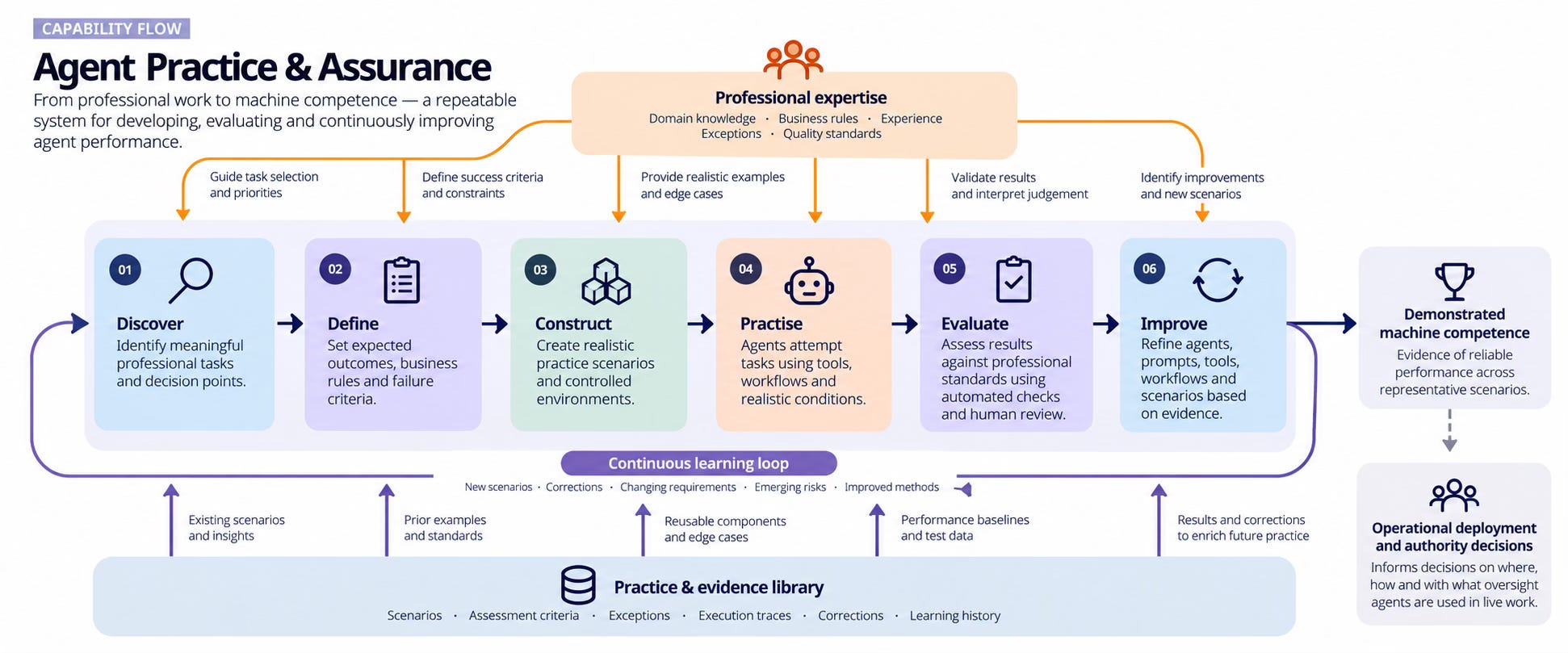
The researchers needed the expertise of people who understood the work itself: what a successful outcome looks like, which rules must be preserved, how exceptions should be handled and which mistakes have the greatest consequences. That expertise was translated into representative tasks, measurable expectations and environments in which an agent could attempt the work, receive feedback and improve.
Rather than treating each agent as a system that must be instructed, deployed and then monitored, organisations could begin developing collections of realistic work scenarios through which agents learn, demonstrate competence and are continually reassessed as models, policies and business requirements change.
I’m calling this emerging capability Agent Practice & Assurance.
Looking at the capability from the outside in
Organisations often approach the development of AI agents from the inside out. Conversations begin with models, tools, orchestration frameworks, evaluation platforms and the technical mechanisms available for improving performance. Whilst these are important, they do not necessarily reveal whether an organisation has the capability to teach agents how to perform its own work successfully.
We prefer to approach emerging capabilities from the opposite direction. Capabilities become visible first through people. They are expressed in the skills individuals develop, the ways teams work together and the routines that repeatedly produce successful outcomes. Only then do we ask what processes support those people, what software enables those processes, what data they depend upon and which core systems provide the underlying infrastructure.
Until recently, organisations have primarily sought to make the required knowledge accessible to AI through documents, retrieval systems, instructions and reusable agent skills. Agent Practice & Assurance introduces another possibility: turning that knowledge into situations in which an agent must demonstrate that it can actually perform the work.
A documented procurement process might describe the approval thresholds for different types of expenditure. A practice environment could present an agent with a series of purchasing scenarios and test whether it configures the correct approvals, recognises conflicting requirements and responds appropriately when essential information is missing.
The capability therefore depends upon more than technical expertise. It requires experienced practitioners who can recognise meaningful work scenarios, specialists who can translate them into repeatable assessments, engineers who can create appropriate environments and teams who can interpret results and improve agent performance.
The Anatomy of Agent Practice & Assurance
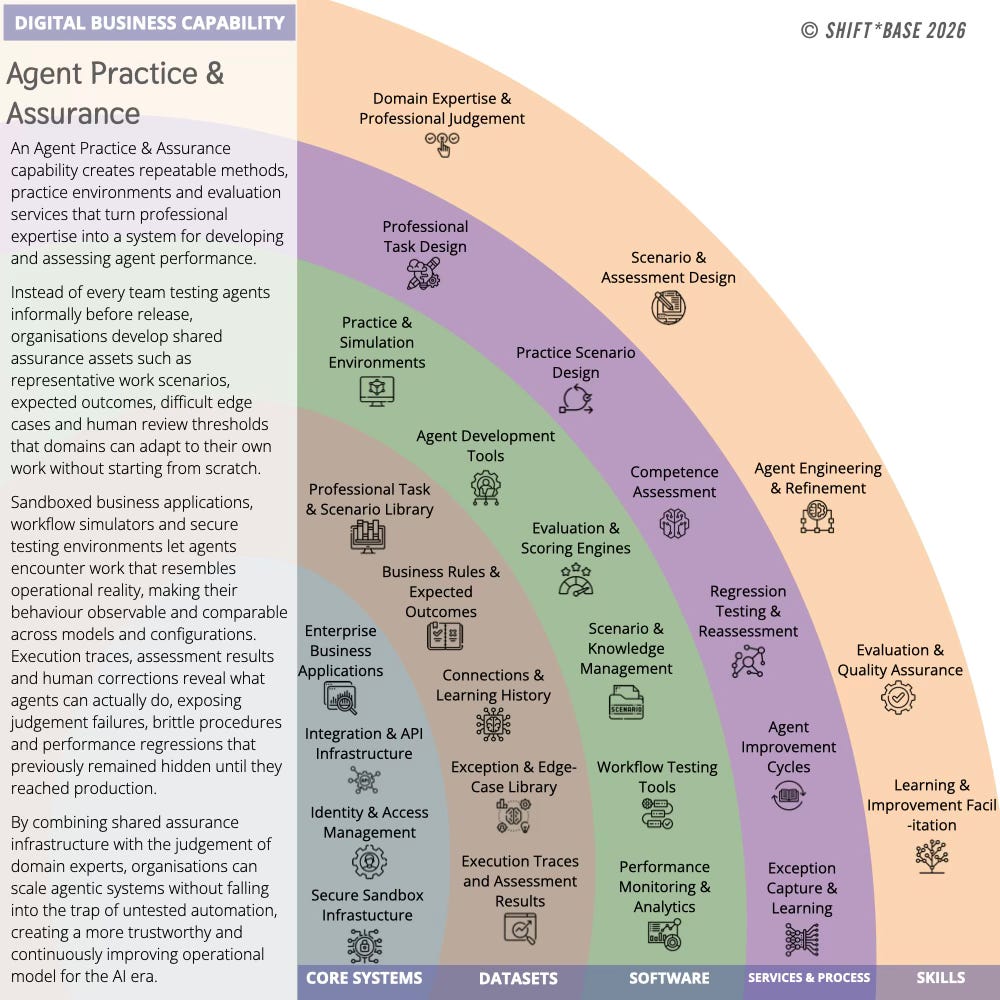
Agent Practice & Assurance is not a single training technique, evaluation framework or technology platform. Each component contributes something different, but it is their interaction that allows organisations to turn professional expertise into a repeatable system for developing, assessing and improving the performance of AI agents.
Skills & People: The capability begins with people who understand what successful professional work looks like. Domain experts, operational practitioners, agent designers and evaluation specialists work together to identify representative tasks, meaningful exceptions, acceptable outcomes and the mistakes that matter most. They need to distinguish between following an established procedure and exercising appropriate judgement when circumstances change.
Services & Processes: Agent Practice & Assurance depends upon repeatable methods for selecting important work scenarios, defining expected outcomes, constructing practice environments, evaluating agent behaviour and using the results to improve performance. This includes deciding which tasks are representative, how difficult cases should be introduced, what constitutes a successful outcome and when human review is required.
Software: Software provides the environments in which agents can practise and their performance can be observed. Sandboxed business applications, workflow simulators, agent development frameworks, automated evaluation tools and monitoring systems allow organisations to recreate realistic tasks, inspect agent behaviour and compare results across different models or configurations.
Data: The capability depends upon a growing collection of representative scenarios, business rules, expected outcomes, execution traces, assessment results and human corrections. This information provides evidence of what agents can perform successfully, where they encounter difficulties and whether subsequent changes improve or degrade performance.
Core Systems: Finally, Agent Practice & Assurance depends upon the enterprise foundations that make realistic practice possible. Business applications, integration services, identity and access management, policy repositories and secure testing environments provide the conditions in which agents can encounter work that resembles operational reality.
Why this capability is emerging now
But this creates a different challenge - an agent may have access to all the relevant information, understand the available tools and follow a carefully designed workflow, yet still fail when confronted with an unusual situation, conflicting requirements or a sequence of decisions that must all be correct for the overall task to succeed.
Traditional software testing provides part of the answer, but agentic systems introduce additional complexity. Their behaviour is not always deterministic, apparently similar situations can produce different outcomes and completing the requested actions does not necessarily mean the work has been performed correctly.
It also changes the economics of agent development, without reusable practice environments, each new agent or significant model change may require teams to reconstruct their understanding of the work, devise new tests and repeat much of the same evaluation effort. With a growing collection of representative scenarios and assessment criteria, organisations could begin reusing that knowledge across multiple agents, technical approaches and business domains.
The opportunity extends beyond improving individual systems, for example:
a scenario that reveals a weakness in one agent might expose a recurring challenge across an entire class of workflows
a change in policy could trigger reassessment of every affected agent.
a difficult exception encountered during real work could become a new practice scenario, strengthening future evaluations and reducing the likelihood of repeating the same mistake
Demonstrating competence does not automatically confer authority to act - decisions about what an agent is permitted to do, under which conditions and with whose accountability remain questions of organisational governance and delegation. Agent Practice & Assurance provides some of the evidence needed to inform those decisions, rather than replacing them.
The Loops & Layers of Agent Practice & Assurance
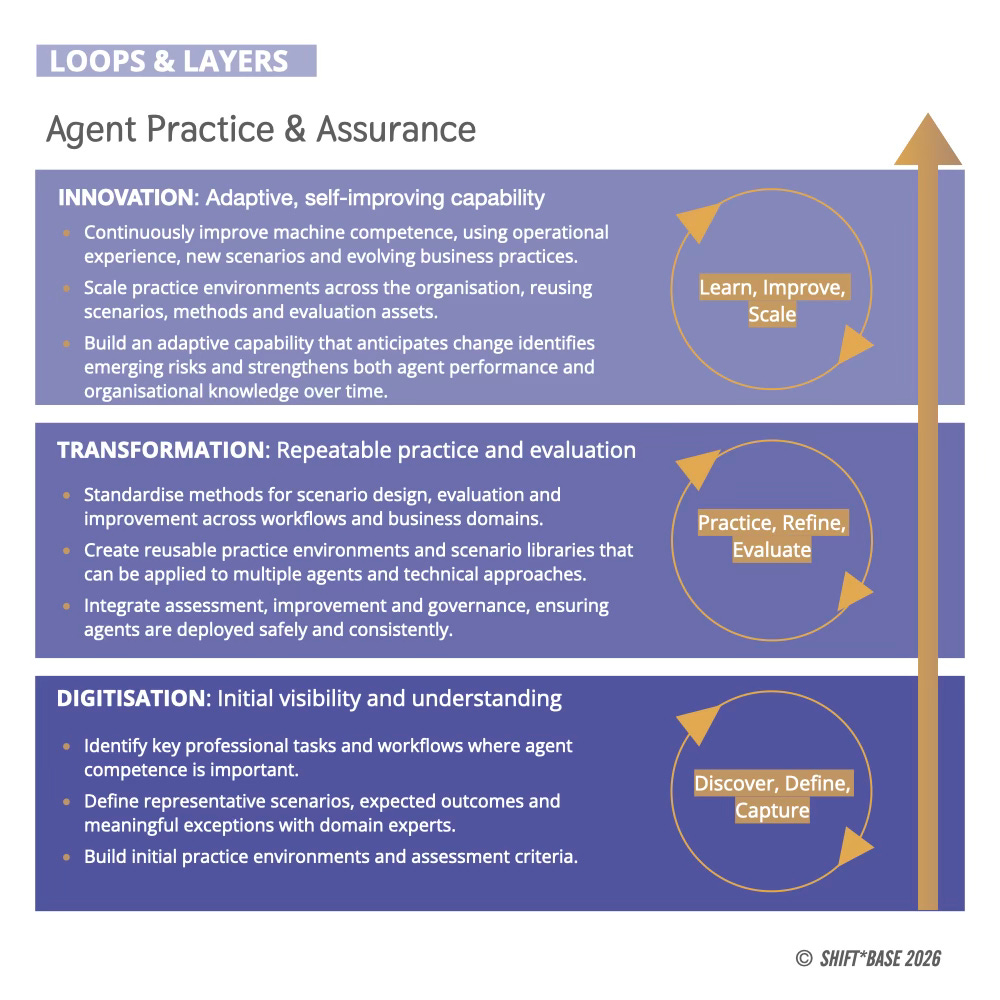
Organisations will develop it through repeated cycles of experimentation, evaluation and improvement, gradually moving from testing individual agents towards building a shared organisational capability for developing machine competence.
This is why we describe capability development through Loops & Layers. Layers represent the broad stages of organisational maturity, whilst loops describe the continuous learning and change that allows organisations to progress between them.
Read on to learn how to evolve this capability in your own organisation.
