


Workforce planning has traditionally relied on a simple unit of analysis: the job. Organisations forecast the work ahead, estimate how many people they’ll need to do it, and recruit or reorganise accordingly.
But jobs have always been an imperfect proxy for what an organisation can actually do. Two people with the same title bring very different capabilities to their work, not to mention the judgement, relationships, shortcuts and contextual knowledge they develop that never appears in the job description. This is part of why organisations have spent years trying to become more skills-based: rather than asking how many engineers or product managers do we need?, start with what do we need to be able to do?
It’s an attractive idea and a hard one to execute. Skills taxonomies balloon beyond manageability, employees tend to be unreliable when self-assessing proficiency, and job descriptions are out of date before the ink has dried. And of course, some of the most valuable organisational knowledge, i.e. how an experienced colleague spots a problem early, or senses when the numbers don’t look right, is difficult to describe at all.
The problem becomes even harder when the work itself is changing quickly. Emerging skills rarely arrive neatly packaged in an established taxonomy or job family. They appear first in projects, new combinations of work and the practices of people experimenting at the edges. Increasingly, they are hybrid too: a domain expert learns to orchestrate agents, a finance professional combines analytical judgement with AI evaluation, or a manager becomes skilled at deciding what to delegate to people and what to delegate to machines.
By the time these combinations become visible in job descriptions, learning catalogues or annual workforce planning cycles, the work may already have moved on.
So organisations were already wrestling with a hard question long before AI agents arrived: how do you build a reliable picture of what your workforce actually knows how to do?
Machines are acquiring surprisingly legible skills
Against this messy picture of human capability, agent skills are precise. An agent skill packages instructions and knowledge for a kind of work into a form an AI agent can repeatedly use, for reporting, content transformation, SEO, and more, with many teams starting to build their own.
Skills in the agentic world follow standard structures, have named owners, include evaluation cases and scoring rubrics, and are automatically tested on submission plus weekly regression tests. You can also design measures to check whether a skill is improving in both accuracy and efficiency. A skill is becoming a living product rather than a one-off document.
That’s a striking contrast with human skills. Agent skills are visible because they’re deliberately constructed with their purpose defined and effectiveness tested.
That makes an agent skill more than context for an AI system. It’s an example of something organisations have tried to do for decades - turn what people know into reusable organisational capability**.** The difference is that this knowledge doesn’t just sit waiting to be found. It can participate in the work.
When expertise no longer resides only in people
For example, if we consider a supply chain risk assessment capability, it is spread across processes, systems and data, but a significant part still sits with people. An experienced professional knows which signals deserve attention, which geopolitical developments matter to a category, or when a reassuring number still warrants a second look. That’s exactly the kind of expertise organisations have always struggled to capture, because much of what makes someone good at it develops through experience and intuition rather than documentation.
Now imagine encoding parts of that work into agent skills: how to gather evidence, apply assessment criteria, spot anomalies or draft an initial risk assessment — a set of skills analysts might use over a period of days. Once deployed as agents, these skills can be used continuously, with outputs evaluated against real cases, weaknesses identified and the overall instruction and rule sets iteratively improved.
The human role shifts to investigating ambiguity, understanding a supplier relationship, exercising judgement about what to do. But a key change has happened - the organisation’s ability to assess supply chain risk no longer resides entirely in its people**.** Some is embodied in human expertise, some codified into agent-executed skills, and some emerges from the interaction between the two.
That’s a different problem from simply deciding which tasks AI can automate. For workforce planners, understanding the future workforce now also means understanding how capability is distributed between people and agents, a distribution that will keep shifting as people learn, agents improve, and more knowledge gets codified.
The workforce plan starts to look different
None of this removes the need for traditional workforce forecasting. Talent leaders will still need to anticipate roles, headcount, recruitment, attrition and cost, and translate those forecasts into decisions the organisation can execute.
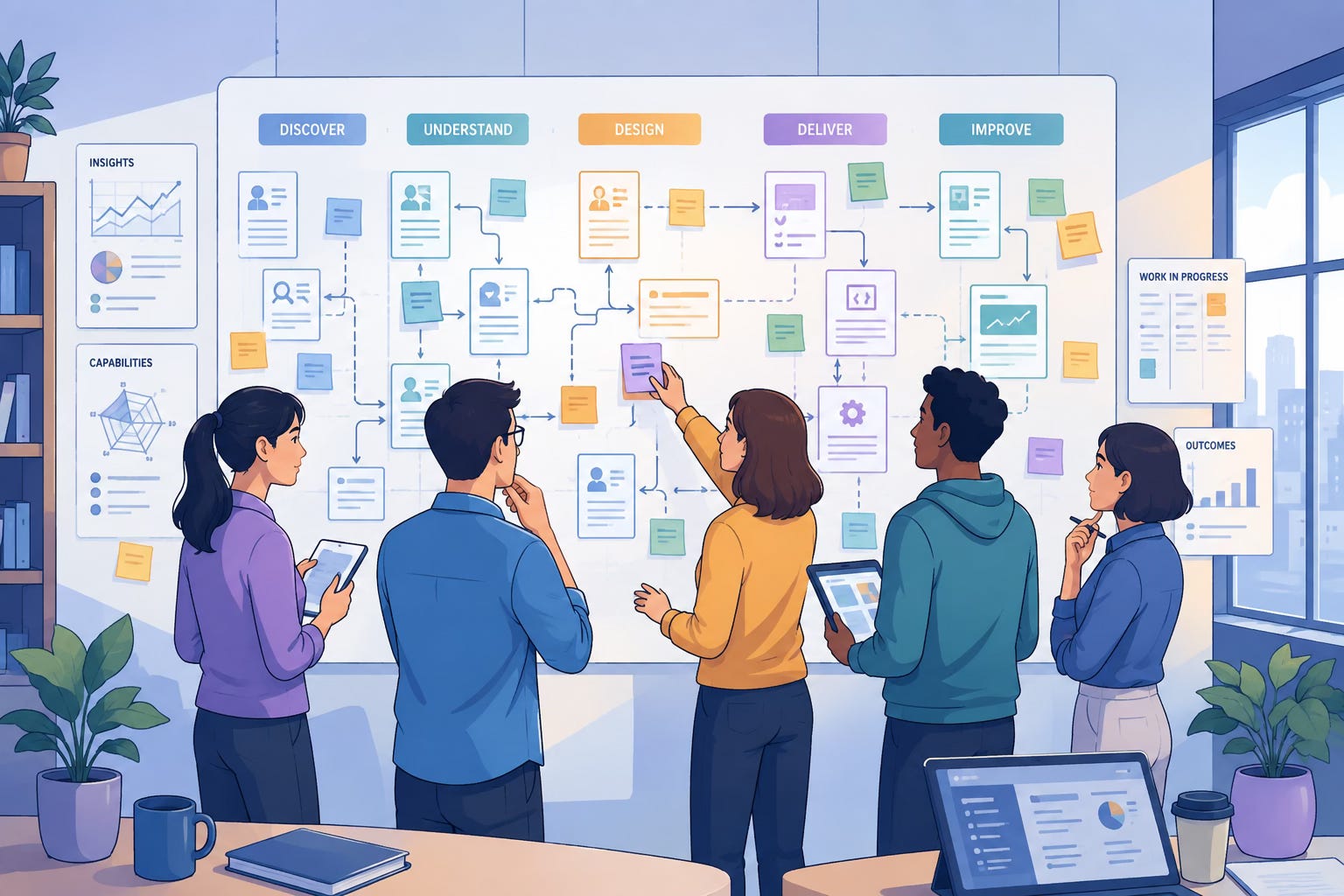
But organisational capabilities provide a more dynamic layer underneath those forecasts. Instead of asking only how many people with a particular role or skill set we will need, we can start from the work itself: what will the organisation need to be able to do, how is that capability changing, and what combination of people and technology will deliver it?
The two views need to work together. Capability mapping and planning help us understand how work and skills are changing; workforce forecasting turns that understanding into practical decisions about people, numbers, investment and time.
Too many firms have fallen into the trap of thinking if AI makes a team 20% more productive, maybe we need 20% fewer people. Real work does not divide so neatly. Take an analyst whose role spans gathering information, routine analysis, investigating anomalies, and making recommendations. An agent might become very good at the first two without being ready to own the rest. The organisation hasn’t automated half an analyst, it’s changed the shape of the job.
A second order problem is also emerging from this reductive approach to AI and jobs. The routine work being handed to agents is often the work through which people learn. Junior employees build judgement by preparing first drafts, getting things wrong, and seeing enough ordinary cases that the extraordinary ones stand out. If that work increasingly becomes an agent skill, organisations need to think about what replaces the learning pathway, otherwise they risk improving today’s productivity whilst weakening tomorrow’s expertise pipeline.
For every capability, organisations increasingly need to understand not just what agents can do, but what people should continue to do, which human skills become more important as the work changes, and where people need continued exposure precisely because that’s how expertise develops.
The decisions organisations make about agent skills today are also decisions about human skills tomorrow.
The portfolio may be bigger than we think
The immediate lesson from Google’s experience of Agent Skill building is that organisations may need to manage agent skills as a portfolio. Once there are hundreds, scattered across teams, questions of ownership, duplication, quality and investment become unavoidable.
But there’s a bigger portfolio alongside it. Organisations are already asking similar questions about their people: what skills do we have, where are the gaps, where should we invest? It’s tempting to treat these as separate exercises, with HR managing human skills and technology teams managing agent skills. But that separation is hard to sustain if both are contributing to the same organisational capabilities.
A finance function planning three years out might need more human expertise in some areas and increasingly mature agent skills in others; most will involve some combination of the two. So an agent skill isn’t just another piece of technology; it’s a piece of organisational capability that has become executable. The portfolio becomes less an inventory of what agents can do and more a picture of where the organisation’s ability to perform its work actually resides: in an expert, a team, an agent skill, or increasingly, in the interaction between all three. And that balance is constantly shifting: a capability that depends on human expertise today might become codified tomorrow, while an agent taking over routine execution might expose new situations that demand deeper human judgement.
What should we codify?
If more knowledge can be turned into executable skills, the temptation is to capture as much as possible. There are good reasons for this. Critical knowledge walking out the door when people leave, and expertise concentrated in a handful of people, are some of the most impactful. Your colleague who instinctively spots a problem probably developed that judgement through years of doing the work, not just by reading documentation.
Not all valuable knowledge is stable enough to be treated as an instruction, either. Some depends on context, relationships or judgement; some is contested or changes as the organisation encounters new situations. Sometimes an expert’s value lies precisely in knowing when the established approach no longer applies.
The goal shouldn’t be to encode every piece of expertise until little remains with people. It should be making deliberate choices about where knowledge lives: some becomes executable because that makes the organisation faster or more resilient; some stays deliberately human because practicing it develops judgement the organisation needs to retain; and often, the most valuable capability emerges from the two developing together.
Start with the capability, not the headcount
Let’s go back to the supply chain risk example. Rather than beginning with how many analysts or procurement specialists might be required in three years, start with the outcome: the organisation needs to be able to continuously assess and respond to supply chain risk. From there, work backwards.
What competencies make that possible? Technical ones such as risk analysis, supply chain intelligence, scenario modelling. Enabling ones such as collaboration and stakeholder management. Transformational ones like strategic judgement, the ability to adapt as conditions change. Underneath those sit more concrete activities: gathering supplier information, interpreting financial indicators, identifying geopolitical exposure, recognising unusual patterns, challenging a supplier’s explanation, recommending an intervention.
Only at this level does it become useful to ask where the work should sit. Some activities are obvious candidates for agent skills. Gathering evidence from multiple sources is high-volume and repeatable, an established risk methodology can be codified and tested, monitoring for change is something machines can do continuously in a way people can’t. Others look very different - e.g., challenging a supplier depends on relationships and context, interpreting an unprecedented situation may require experience that can’t yet be codified, and a consequential decision carries accountability the organisation may deliberately want to keep with a person. Between the two sits a large territory where the best answer is some combination of human and machine capability.
This suggests a different sequence for workforce planning:
Capability → Competencies → Skills → Allocation → Learning
Then ask a question that’s often forgotten - what does that allocation do to learning? If an agent takes over every initial supplier assessment, how does a new procurement professional learn what a good one looks like? If an agent frees up hours of routine preparation, what higher-value skills could people now develop instead? Curiosity, learning agility and the confidence to challenge an AI-generated recommendation aren’t easily allocated between human and machine. They shape whether human and agent skills improve together or drift apart.
The resulting plan adds a capability lens to the traditional forecast of roles and headcount, giving talent leaders a more dynamic picture of what the organisation needs to be able to do and how that capability should be assembled. One agent might use dozens of reusable skills, one skill might support hundreds of people or multiple agents, and the same underlying knowledge might appear in a human expert, an agent skill, and a workflow used by an entire function.
That changes the planning question. We can begin to ask the really important ones, such as:
what do we need to be capable of,
what should our people become exceptionally good at,
what should our agents become exceptionally good at, and
how do we design the work so both continue to learn?
From periodic planning to continuous sensing
There is another role for agents in this model. They don’t only need to feature in the workforce plan; they could help us build a better one.
One of the persistent weaknesses of workforce planning is the gap between how quickly work changes and how slowly our picture of the workforce catches up.
Much of the evidence of those changes already exists inside organisations, scattered across project activity, learning, recruitment, work outputs, capability assessments and the systems through which people actually do their jobs.
Rather than relying predominantly on periodic exercises to update a skills taxonomy, an organisation could look for emerging clusters of work and expertise, identify where demand for a capability is growing, spot new combinations of skills appearing across teams, or detect where the work being performed is diverging from the roles and skills the organisation thinks it has.
That does not mean allowing an AI system to decide the workforce plan. The signals will still need interpretation, context and judgement. But it could give talent leaders a much more dynamic evidence base from which to make those decisions.
This creates an interesting second role for agentic AI in workforce planning. Agents become both part of the capability being planned and part of the sensing system that helps us understand how that capability is changing.
The result could be a shift from workforce planning as a predominantly periodic forecasting exercise towards something more continuous: sensing changes in work and capability as they emerge, interpreting what they mean, and then feeding that intelligence back into the forecasts, investment decisions and workforce actions talent leaders still need to make.
Who owns the skills portfolio?
If this direction continues, there’s an awkward question around the corner: who is responsible for all of this? Today the pieces sit in different parts of the organisation, HR, learning teams, knowledge management, technology, and the business teams that hold the domain expertise. Agent skills cut across all of these boundaries.
Google hit this problem quickly: initial skills came from a cross-functional group, but as product teams began creating their own, common standards became necessary, such as owners, evaluation criteria, quality controls, lifecycle management. A familiar pattern: once something is reusable and widely distributed enough, informal ownership stops working.
But an enterprise skills portfolio is more complicated than a software portfolio, because decisions about agent skills change how work is performed, what’s codified, and what people need to learn. That makes it hard to imagine agent skills remaining solely a technology concern. Much of the knowledge needs to stay close to the teams that understand the work. The harder challenge is establishing enough shared discipline around locally-owned skills that the organisation understands what it’s accumulating: common approaches to ownership and evaluation, visible dependencies between human and agent skills, and workforce planning that considers investment in people, learning, codification and agents together.
Someone needs to steward the relationship between what the organisation needs to be able to do, what its people know how to do, and what it’s teaching its agents to do.
Two portfolios are starting to collide
Eventually, the human skills portfolio and the agent skills portfolio may stop making sense as separate things. Both are answers to the same older question: what does this organisation know how to do?
Another question is emerging, which deserves our time, attention and honesty. If a skill can be codified, tested, and improved faster than a person can be trained, why would an organisation keep investing in the slower version?
The honest answer, for now, is that people generate the judgement agents don’t yet have, and agents can’t produce what they haven’t learned from people. That’s a fragile equilibrium, not a stable design. It holds only as long as organisations keep deliberately feeding the loop: sending people into the ambiguous cases, funding the slow apprenticeships, treating codification as a choice rather than a default. And the longer that question remains unanswered, the higher the chance the market answers it for you, quarter by quarter.
Nobody currently owns that equilibrium. HR owns ‘people’. Engineering owns ‘agents’. But in many cases, no-one owns the relationship between them, and therefore also the decision, made a hundred times a week in a hundred different teams, about which knowledge stays human and which gets executed with agents.
That may be the real workforce planning question for the next decade: not how many people, not how many agents, but who is responsible for making sure the organisation doesn’t automate away its own capacity to keep learning.