


Agentic AI is showing great promise in coding and personal productivity, but the shift from personal to organisational agent usage in the enterprise is harder and more complicated than it looks. It also heralds a profound shift in what we consider to be ‘work’ and ‘workers’, and that will take some getting used to.
How should leaders balance internal demand for agents in the short term with the need to build out the invisible infrastructure they rely on to make them safe, relevant and reliable over the long term?
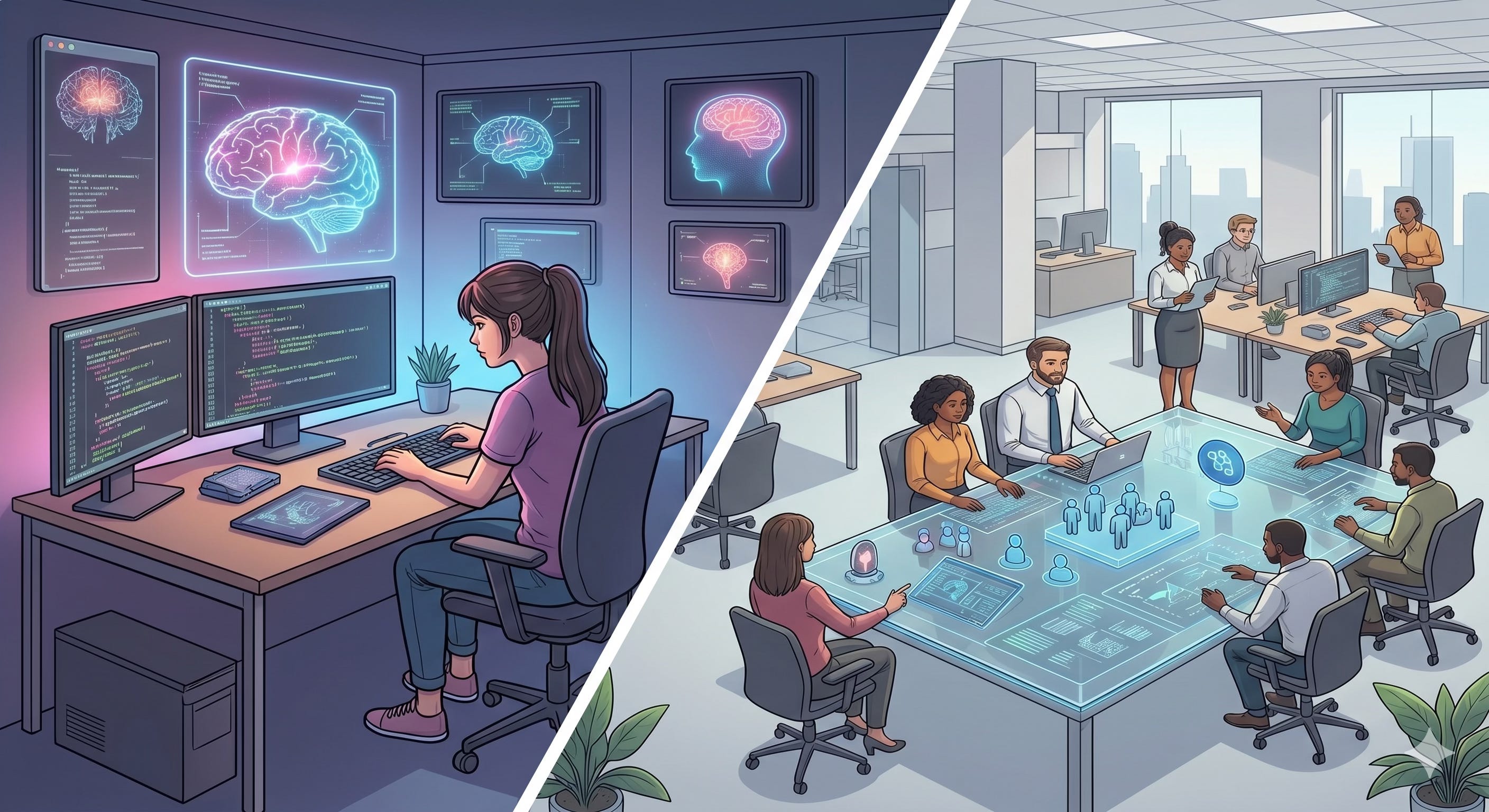
A social technology that could transform human collaboration?
Rohit Krishnan is fascinated by this new cadre of what he calls Homo Agenticus Sapiens. He recently shared a thought-provoking ‘live’ list of ways in which agents are different to people and what this means for how we coordinate them. Such observations are useful in helping us understand how much we have to learn about agentic AI.
We often think of agents as units of automation, but they are more than that, and could play an interesting role in helping us improve the experience of work.
The application of even limited synthetic intelligence to process management and the coordination of work could enable us to run smarter organisations with less of the bureaucratic management overhead that is such a cost drag today. But also, by making the infrastructure of organisational coordination more machine-like, we can free people up from so much of the pointless busy work they do today and let them focus on what humans do best.
At least that is the hope.
Henry Farrell and Cosma Rohilla Shalizi considered this from a social and political science perspective in their recent (substantial) paper entitled AI as Social Technology, arguing that “AI does not hold out the promise of truly post-human bureaucracy.” It is an excellent read, but perhaps too distracted by the craziness of US politics, policy and the Doge episode to fully consider the humanising potential of de-bureaucratisation and peer-to-peer coordination in less dystopian environments. But the authors raise some quite reasonable questions:
The interesting questions involve the interaction between the ways bureaucracies abstract reality and the coarse-grainings that new AI applications will lead to. When will one system compensate for the deficiencies of the other? When will their different flavors of lossiness prove mutually reinforcing? What new problems may result from combining very different systems for managing complexity that are themselves highly complex? How will power relations change as a result? Who will benefit, and who will be hurt? These and other questions might be asked, pari passu about the relationship between AI and other social technologies such as markets and democracy too. We absolutely ought to start asking them.
The potential for agentic AI to support human collaboration was outlined and explored recently by Timour Kosters, who is studying how to use it to bring people together to achieve common goals without top-down management control.
The current discourse about AI agents centers mostly on personal agency … But personal agency is just the beginning. The question I am more interested in is what happens when agents become coordination technology: shared tooling that helps groups of humans achieve their goals. Can agents enable new interfaces for collaboration, helping people turn shared context into shared action? If agents can expand what we can do together, they could become new infrastructure for communities, cities, movements, polities, and even democracies.
I share this optimism that agentic technologies could bring exciting new horizons for cooperation by doing the boring but necessary background work of coordination, information aggregation and admin.
We tend to think a lot about agentic capabilities, but we also need to focus on agentic responsibilities if they are to co-exist with us in a messy human world.
In a recent piece for O’Reilly Radar, Artur Huk builds on Carl Hewitt’s Actor model to describe what you might call a Rendanheyi-infused agent model where responsibilities and micro-contracts bring greater governance and control to multi-agent interactions:
The Responsibility-Oriented Agent (ROA) does not invent a new distributed-systems primitive. Instead, it composes proven patterns—bounded actors, RBAC-style authority envelopes, audit trails, and execution-boundary validation—around an unpredictable LLM core. In truth, ROA is closer to a decision actor than a full computational actor: It maintains its own internal state but does not directly mutate the external world. Within a stable role, a fixed mission, and a machine-enforceable contract, it receives business events, reasons over relevant context, and emits a
PolicyProposalfor the Runtime to validate.
Given the success of the Rendanheyi model, perhaps agentic AI coordination can help ordinary firms enjoy some of its benefits without visionary leadership or wholesale organisational re-design.
Building the new vs. changing the old
It goes without saying that the challenges of building agentically-enhanced organisations should not to be underestimated.
If you are building agentic business infrastructure from scratch, then there are at least some architectural and infrastructural options available that are good enough to build on and evolve as new tools, tech and capabilities enter the market. Anthropic is rapidly evolving its enterprise offerings and tools, but Google and Microsoft are also developing strong platforms.
Google’s recent I/O event was heavily focused on agentic AI, and this seems to be a key focus for bringing together the company’s various AI tools into an integrated platform.
Microsoft is also working hard to evolve their agentic capabilities, with the recent release of Agent 365 bringing a control plane to Copilot studio and their Agent Framework; plus they have the advantage of being the default platform choice for most larger enterprises.
But when you really engage with the current reality and constraints inside large firms who typically suffer from legacy architecture and tools, an over-reliance on lowest-common-denominator last-gen SaaS platforms, and with a patchy history of outsourcing a lot of process work, then you start to sympathise with IT functions who are trying to respond to the growing clamour from their colleagues for agentic AI.
This is what HBR described earlier this year as the last-mile problem for enterprise AI, and their advice to treat this as an opportunity to do clean-sheet process redesign makes a lot of sense.
Just scanning my feeds for the past week is enough to make my head spin in terms of the emerging challenges agentic projects are facing:
The pipeline tax: why putting together real-time data pipelines to support agentic AI is harder than we thought, and methods like RAG are not going to cut it.
Context and memory persistence for long-running tasks: why we need better techniques for avoiding agentic drift over time.
Don’t blame the model blame the harness: why harness engineering requires new developer skills to support agentic AI.
How to prevent / manage agent sprawl if, as analysts predict, large firms end up with 100k+ agents over time.
However, the more pressing challenge, and in some ways the most worrying for many CIOs because of its unpredictability, is ballooning token costs.
Azeem Azhar and team have ben tracking this recently, and also looking at how elasticity of demand means more agentic apps become economical as token costs fall, which means the total spend continues to increase.
Today’s architectural decisions will shape the future of the agentic enterprise
Surely intelligence is not something to be outsourced over the long term, especially given the unpredictability over compute and token costs?
If we break down the level of intelligence individual agents need to do most tasks in the enterprise today, small or open models that run on your own infrastructure are sufficient for the most part, with the added benefits of more local post-training, lower latency and greater governance and control, in addition to avoiding what could be a very expensive form of vendor lock-in. Using external frontier models only for higher-level reasoning and knowledge synthesis could minimise or at least hedge against the impact of rising token costs.
But it is a brave CIO who sets a course for model sovereignty today in such a fast-changing environment. Right now there is so much work to be done at the infrastructural, data, services and apps/agents levels - all whilst keeping the lights on and putting out fires - regardless of model choice. There is a long journey of discovery ahead for agentic AI; it will not be a one-and-done shift, but more of a gradual transition.
One way or another, we need to think in terms of platforms and architectural layers, and focus on building out our own capabilities rather than ending up dependent on external vendor lock-in for what are likely to become core features of the organisation.
At the same time, however, CIOs face strong internal demand for AI tools today, and organisations need to get people thinking and learning about what agentic AI can do. If they respond to this demand by buying stand-alone point solutions that don’t deliver on integration promises, or continue the dependence on last-generation SaaS platforms with AI magic dust sprinkled over 1990s interfaces, they will be storing up hard problems (and an unmanageable estate) for later.
Of course everyone wants Claude Cowork and other advanced frontier models! For software development that is probably a good, if expensive, choice. But for most other enterprise use cases, a wholly owned open model approach, or running with the Microsoft stack if that is already the basis of your digital workplace, is likely to be enough to handle most use cases and capability needs.
A better interim solution might be to stand up just enough infrastructure in terms of connected data, MCP servers and automatable service end-points to allow people to start using personal agents in their work, and begin sharing skills, context and ideas. This would already be a step up from chatbots, and perhaps buy time and understanding for the hard work of creating the underlying infrastructure that agentic AI will need to go from personal to organisational use cases and agents.
The cost problem is driven by variance rather than infrastructure—the reasoner replans and retries, and the goal it’s pursuing is reconstructed from context on each pass, so drift compounds as the run lengthens. Consequently ‘task’ is not a stable unit of decomposition when the reasoning that structures the task is the expensive and variable part.
The tractable design question is finding problems with termination conditions where an external criterion decides done, not the agent’s judgment. Controlling cost then becomes a question of selection and scoping of workloads. You’re not making agentic systems cheaper; you’re choosing which problems are structurally suited to them.
Edit: typos! Argh!