


In a recent AI learning session, someone suggested a useful application of AI would be to create more accurate and detailed job descriptions, but it strikes me that embedding such a constraining tool at a time of significant transformation could lead us in the wrong direction.
As we develop increasingly sophisticated AI agents, we are learning to specify their responsibilities, instructions, permissions, decision boundaries and expected outputs in considerable detail.
Perhaps we should be doing the opposite for humans.
For more than a century, organisations have pursued efficiency by dividing work into defined tasks, allocating responsibilities and establishing clear expectations about what people should do. This approach made sense in an industrial economy built around standardisation and predictable execution, but it has proved remarkably persistent even as the nature of work has changed.
We do not have to start redesigning from scratch. Organisations experimenting with self-management, distributed authority and negotiated accountability have spent decades developing alternatives to prescribed roles.
The limits of the job description
The conventional job description carries an inheritance from Taylor’s scientific management: the belief that efficiency can be achieved by analysing work, breaking it into defined activities and allocating responsibility for their execution.
Job descriptions reinforce this separation by defining the boundaries of individual responsibility, often placing greater emphasis on what people are expected to do than on their capacity to question, improve or extend the work itself.
The reality of work has always been more fluid. Deloitte’s research found that 71% of surveyed workers perform at least some activities outside their job descriptions, while only 24% report doing the same work as colleagues with identical job titles and levels. AI is accelerating this divergence between prescribed roles and actual contributions. OpenAI’s 2026 research found that 43.5% of occupation-specific work messages involved tasks associated with occupations other than the user’s own.
Yet there is a danger that organisations respond by mapping every task, identifying what agents can perform and rewriting human job descriptions around whatever remains. This would preserve the underlying logic of scientific management, simply redistributing execution between humans and machines while leaving the design and direction of work largely unchanged.
If agents can take on an increasing share of well-specified activities, people throughout the organisation could be given greater responsibility for identifying opportunities, exercising judgement, developing capabilities and improving how work gets done.
The autonomy dividend has nowhere to go
Genpact’s November 2026 Autonomy in Practice report, based on a survey of 2,005 senior enterprise decision-makers, found that 79% have agents in production, yet only 9% report having completed significant operating model transformation. Just 15% fully connect AI value to specific profit and loss lines, and on average, respondents report that fewer than half of their AI initiatives deliver the expected value. Among respondents with agents in production, 92% reported maintaining or increasing their human workforce.
An agent that reduces the time required to process an invoice, review a contract or prepare a report creates potential capacity. The organisation might process more transactions, improve service quality, develop new offerings or redirect people’s attention towards more complex problems. Equally, the time released might simply disappear into existing workloads, leaving the underlying organisation largely unchanged.
We have previously explored the idea of released capacity and the challenge of converting machine-workdays into meaningful business outcomes. But there is another dimension to the autonomy dividend: who decides how that capacity is used? If management simply reallocates the time saved into another set of prescribed activities, the organisation may become more productive without changing its underlying approach to human work.
A more ambitious response would give people greater authority to identify opportunities, negotiate new commitments, assemble human and AI capabilities, and reshape their contribution as circumstances evolve.
We already have alternatives to prescribed roles
At Morning Star, the Californian tomato processing company, employees develop Colleague Letters of Understanding(CLOUs), negotiating their responsibilities, performance expectations and commitments directly with the colleagues who depend on their work.
Chinese appliance manufacturer Haier has taken a different approach through its Rendanheyi model, organising work into entrepreneurial microenterprises focused on customer outcomes. At French manufacturer FAVI, small, customer-focused production teams have similarly been given authority to organise their own work, while Dutch healthcare organisation Buurtzorg has demonstrated how self-managing nursing teams can coordinate complex care with limited managerial oversight.
These organisations have not eliminated structure or accountability. They have developed different mechanisms for creating them, using negotiated commitments, shared purpose, peer relationships and decision-making authority close to the work. Crucially, people participate in shaping the responsibilities they undertake and the methods they use to fulfil them.
Drawing on Morning Star's approach to negotiated commitments, we've developed a simple technique for rethinking human contributions alongside emerging agent capabilities.
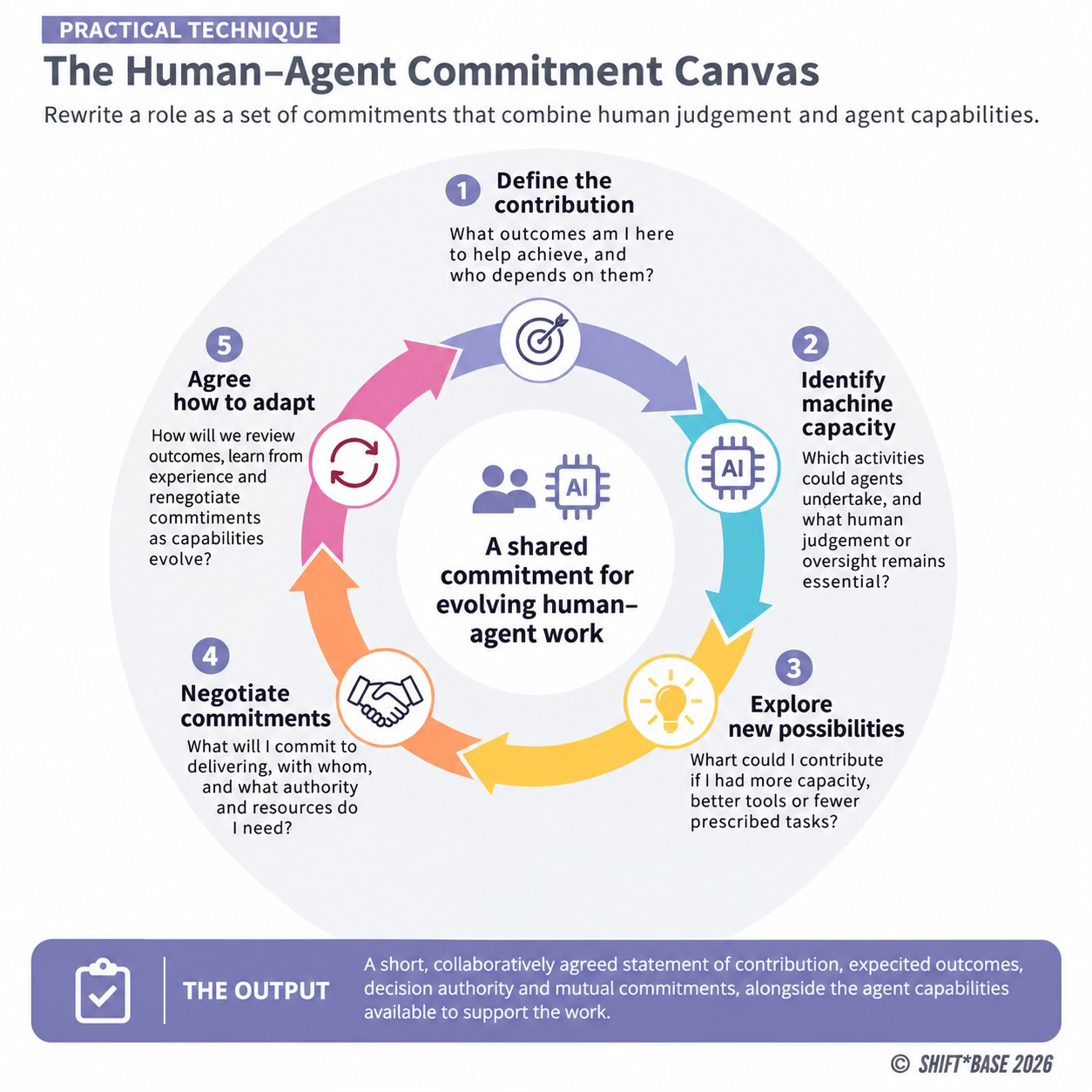
There is also an interesting parallel with emerging approaches to multi-agent coordination, where agents can negotiate tasks, exchange commitments and establish contracts governing their interactions. Morning Star’s CLOUs offer a human precedent for this kind of coordination through explicit, mutually understood obligations. In a human-AI organisation, negotiated human commitments and machine-readable agent contracts could become complementary ways of coordinating work across a changing network of people and digital capabilities.
These examples also point towards an interesting opportunity for AI itself. Self-management requires considerable coordination: making commitments visible, understanding dependencies, identifying gaps and keeping colleagues informed as responsibilities change. AI could help reduce that burden, making distributed accountability easier to sustain as organisations grow. The challenge would be to use it to support people’s autonomy, rather than introduce a new form of algorithmic management.
Precise agents, adaptable humans
For humans, we should arguably be moving in the opposite direction. It means being clearer about the outcomes people are responsible for while giving them more freedom to determine how those outcomes are achieved.
One way to approach this is to distinguish between three complementary elements of organisational design:
Capability definitions describe what the organisation needs to be able to achieve, independently of who or what performs the work.
Agent specifications establish what digital workers can do, the resources they can access, the decisions they can make and the conditions under which they must seek human involvement.
Human commitments, negotiated with colleagues and teams, establish responsibility for outcomes, mutual obligations and the authority to adapt how work is performed.
Read on to explore how organisations can turn growing machine capacity into greater human autonomy, and make the most of both.
