


This is Part 2 of our exploration of Human–AI Teaming Readiness. In Part 1, we defined the coordination problem that emerges when humans and agents share the same work environment, and introduced Align → Bound → Learn as a lightweight system for designing shared context, boundaries and learning loops for centaur teams. In this edition, we move up a level to look at how leaders maintain the integrity of the collaboration world itself, through the Collaboration Health View and by treating Human–AI Teaming Readiness as a core organisational capability, not a local experiment. If you missed Part 1, you can read it here.Many organisations have spent 2025 pouring money into AI licences, copilots and orchestration platforms, often long before they have invested the leadership attention required to make their processes and work explainable to AI agents.
The result is a familiar disconnect: enormous budget allocation at the technology layer, but without enough time spent articulating the rules, trade-offs, priorities and judgment criteria that govern how work happens.
Even without agents in the loop, many leaders are already feeling the cost of this missing context:
Teams interpret the same strategic message in different ways.
Boundaries of autonomy shift depending on who is in the room.
Quality thresholds vary wildly between functions.
Escalations proliferate because no one is sure who owns what under changing conditions.
These symptoms are not new. They are signals that the world in which teams collaborate is weaker or more fragmented than anyone realises. World-building may sound abstract, but leaders practise it every day through the expectations they set, the meanings they reinforce, the boundaries they uphold, and the language they use.
This is the part of leadership that has always held organisations together.
But as mixed-intelligence work begins to spread, the consequences of weak or drifting worlds are becoming impossible to ignore. Context that was once tacit must now be made explicit. Coherence that once emerged through proximity now requires deliberate maintenance. And coordination that once relied on shared human intuition must be authored in a form that both humans and machines can recognise.
Seeing The Drift Problem
Even in organisations that have spent years improving team-level alignment, intent and ways of working through agile transformation, coherence often collapses the moment those teams interact with the wider hierarchy.
Teams may establish:
clear intent,
shared priorities,
strong decision principles,
and stable rituals for coordination.
Yet when they meet the rest of the organisation, the steering structures, budgeting cycles, risk gates, and inherited decision norms, the world those teams have built can evaporate almost instantly. Suddenly:
vocabulary no longer matches,
priorities are interpreted differently,
escalation paths contradict team autonomy,
and decisions that made sense inside the team lose meaning outside it.
This is already world drift, leaders are beginning to feel its symptoms long before AI enters the picture:
the same strategy feels different in every function,
ownership becomes ambiguous the moment work crosses boundaries,
quality thresholds vary depending on which leader signs off,
and small misunderstandings accumulate into larger coordination friction.
These are early indicators that the organisational world, the shared logic that collaboration depends on, is losing definition.
Agents will inherit the world as it is, not as leaders wish it were.
If alignment is inconsistent, they amplify inconsistency.
If thresholds vary, they surface those variations.
If boundaries are vague, they multiply escalations or silent failures.
AI reveals drift and friction rather than creating it. So how can leaders start to recognise the dissonance of world drift?
Technique # 1: Tracking Drift Signals
A micro-practice for reading the current state of your collaboration world
What
A 10-minute weekly observation practice that helps leaders detect the earliest signs of world drift.
Why
Because drift doesn’t appear as a crisis, it appears as small inconsistencies that compound quietly until coordination feels harder than it should.
Who
Any leader responsible for cross-functional work or distributed teams.
How
After a meeting or decision, ask yourself:
Vocabulary: Did we all use the same language for what “good” meant?
Mental Model: Were we really working from the same understanding of the goal?
Ownership: Did decision rights remain clear or shift unpredictably?
These micro-signals tell you where your world is stable and where meaning is beginning to fragment.
Technique # 2: The Context Ledger
Micro-codification that strengthens the world one edit at a time
What it is
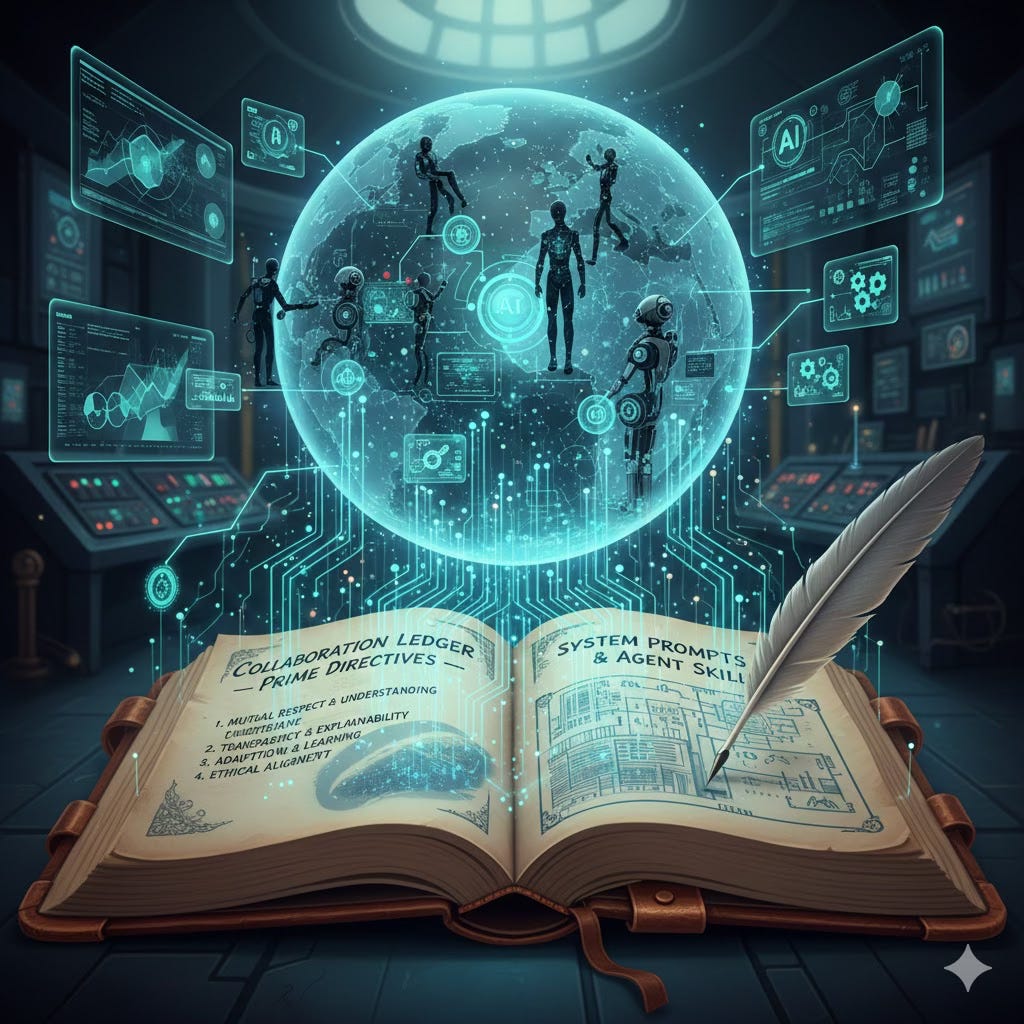
A running, publicly visible ledger where teams contribute one sentence each week describing a rule, boundary, trade-off or guideline that could be added to collaboration guidance, system prompts and agent skills to improve the way people and agents operate.
Why it matters
Most context failures come from missing or inconsistent meaning.
Leaders think they have alignment. In reality, everyone is improvising differently.
A weekly cadence of micro-codification prevents drift, distributes authorship, and prepares organisations for AI agents that will need the same clarity.
Who should use it
Teams beginning to experience drift, or preparing to introduce agents.
How it works
Once a week, teams add one crisp rule such as:
“Escalate when customer impact exceeds X, regardless of channel.”
“Risk level ‘high’ means a downstream effect on more than two functions.”
“Agents may flag priority but humans make trade-offs between priorities.”
“A ‘quality issue’ means deviation from X, not personal preference.”
Leaders curate, combine, and lightly edit these into a Context Ledger, the beginnings of an organisational grammar for centaur teams.
Over time, this becomes the substrate for:
shared operational meaning,
consistent decision-making,
and eventually, system-level prompts and agent rulesets.
Reading the World, Not Just the Work
These two techniques give leaders an on-ramp into world-building: a way to see drift and begin stabilise it, and to build capabilities before agents join the team.
But as organisations introduce more agents into their operating environments, something subtler begins to happen: the collaboration world develops a life of its own.
Interactions between humans and agents shape new norms. Adjacent workflows influence one another in ways no-one planned. Local learning compounds unevenly. Meaning shifts faster in some pockets than others.
Even well-aligned teams can wake up inside a context that feels quietly different from the one they thought they had created. This is the moment where leadership attention must rise above individual decisions or team routines. The question becomes one of world integrity:
Is the environment that supports mixed-intelligence work holding its shape, or is drift accumulating across the structural, cultural, or experiential layers of the organisation?
Leaders need a practice for reading, and lightly editing, the world itself.
That is the purpose of the Collaboration Health View, which evolves our earlier on-ramp techniques to a new level.
The Higher-Altitude Practice: The Collaboration Health View
In the world-building model, coherence never comes from initial design alone. It comes from continuous maintenance, from the ability to periodically rise above day-to-day activity and ask whether the world still makes sense to those living and acting within it.
The Collaboration Health View is that maintenance practice for centaur teams.
Not “Is the system working?”
But “Is the world of collaboration still coherent?”
This is not an operational review and not a technical audit. It is a form of world stewardship, a periodic act of sense-making that allows leaders to observe how shared meaning between humans and agents is evolving over time.
Its purpose is simple:
to detect where coordination is strengthening,
where it is quietly drifting,
and where the language of collaboration is beginning to fracture under pressure.
What Leaders Look For
At this altitude, leaders are not just reading performance. They are reading world integrity.
Signals of strengthening collaboration:
Stable division between human judgment and agent execution
Transparent decision provenance
Deliberate, not habitual, human override
A shared vocabulary of priority, risk and quality in everyday use
Signals of drift:
Shadow automation outside shared boundaries
Conflicting agent behaviours across adjacent worlds
Growing reliance on post-hoc control rather than pre-emptive boundary design
Displacement of responsibility (“the system decided”)
These are the early signs that the world’s systems and culture are beginning to slip out of alignment.
Cadence and Outputs
The Collaboration Health View mirrors other world-maintenance practices:
regular, light-touch cadence
high leverage
low ceremony
persistent over time
Its outputs are not plans or mandates. They are small edits to the world:
boundary adjustments
vocabulary clarifications
intent realignment
narrative renewal
This is how coherence is kept alive in an agentic environment by continuously tending the conditions that generate it.
Questions for Leaders to Test Collaboration Health
A Collaboration Health View becomes most powerful when it is grounded in lived experience. These questions help leaders sense the state of their own environment:
Do humans and agents still appear to act from the same definition of success?
Where did we recently see an agent behave correctly in isolation but incorrectly in context?
What vocabulary has begun to fragment across teams or systems?
Where are humans overriding too often, or not often enough?
Which boundaries felt clear during design but ambiguous in practice?
Where is escalation happening too late, or too reflexively?
What small world-edits (language, boundaries, examples, narratives) would remove friction tomorrow?
These are not diagnostic questions for technologists. They are world-reading questions for leaders.
Read on to learn how to make human–AI teaming readiness a core organisational capability to support future developments in agentic AI and automation, and what this means for the future of leadership.
