


Neither human nor AI intelligence should be regarded as a finite resource to be captured or owned. Instead, we should think about how we grow and evolve intelligence in the real world. In enterprise AI, this means we should pay more attention to coordinating and compounding the new forms of intelligence that people are starting to generate with agentic technologies.
But to do this, we also need to reverse 30 years of management orthodoxy that has gradually taken human judgement and autonomy out of work.
Intelligence shared is intelligence multiplied
Venkatesh Rao uses a historical analogy about the switch from mercantilism to capitalism to make the argument that rather than fearing the impact of AI on apparently fixed resource pools like jobs, we should instead embrace the abundance of intelligence and look forward to what it will produce:
We are moving toward a world in which an ordinary person can command quantities and varieties of intelligence that would previously have required teams of highly trained specialists. Just as I can enjoy food without knowing how to farm, I can increasingly enjoy the products of intelligence without knowing how to produce them myself.
The crucial economic question then becomes not how much intelligence people can produce, but how much intelligence they can find uses for.
The DeepMind Institute recently shared an interesting essay by Alex Imas, Andrew Koh, and Shane Legg about how and when AGI might lead to economic transformation, drawing on a more technical paper that attempts to quantify AI’s impact on firms and the job market.
The essay looks at four analytical capability regimes: minimal AGI, supercompetent AI, supercooperative AI, and artificial superintelligence (ASI).
The authors argue that in attempting to measure the capability of individual agents or models, we have missed the compounding factor of coordination. ASI requires supercompetent agents operating together in supercooperative architectures; but even pre-ASI agentic capabilities deployed in a supercooperative way have the ability to fundamentally transform the nature of the firm, and possibly also economies as a whole.
Firms themselves are a kind of primitive coordination intelligence that creates collective capability from a patchwork of bounded, finite individual capabilities:
The result is mosaic intelligence: the organization builds a collective capability that captures the strengths of every specialist while eliminating the gaps between all of them. By filling in the jaggedness across worker profiles, mosaic intelligence outperforms every individual in it.
The introduction of railroads and the telegraph in the late 19th century enabled organisations to scale more effectively by improving coordination, and arguably the PC and later the internet did something similar in the following century. But firms still had natural scaling limits because of increasing entropy and coordination costs when they became too large for manual management to operate effectively.
As the DeepMind Institute authors argue, however, if agentic supercooperation becomes a workable reality, the art of the possible for organisations might change again, and finding the right combination of humans + AI could be the catalyst.
Asking “is the model better than a human?” is therefore focusing on the wrong object of economic analysis. In a competitive market, the right question is whether an organization of AI agents can surpass an organization of humans, or a blend of humans and agents…
Separating competence and coordination yields an important insight about economic transformation: competence reshapes the economy gradually, whereas coordination abruptly transforms it.
Humans compounding the learning loops
We tend to quantify this potential only in economic terms, but its wider impact on quality of life will matter more than GDP growth or cost savings, assuming the mercantilism vs capitalism lessons Rao points to are heeded, and we treat the whole population as valuable users and consumers of intelligence regardless of their job.
The intelligence we are talking about here might be synthetic, but it is essentially a distillation of human collective intelligence and collaborative world knowledge, and we should remember that. If the purpose of innovation is to improve the human experience, rather than just to be weaponised in a zero-sum mercantilist game of thrones, then the next phase is about how we co-evolve with AI and not how quickly we can replace people by recreating an automated version of what we had before.
Model intelligence is really just the beginning. We can compound intelligence through human + AI learning loops based on how we use it in the real world, similar to the role of network effects that drove rapid capability gains in networked systems during the first decade of this century.
Enrique Dans from IE University in Madrid recently shared one idea for how to compound intelligence, which is to learn from Google’s PageRank as a way for employees to collaboratively guide AI learning loops.
The next breakthrough in corporate AI could unlock value in something companies already produce every day: experience. If that experience becomes accumulated learning that the company controls and retains as models change, the competitive advantage starts to belong to the business itself.
PageRank unlocked value in something the web was already producing: links. Similarly, the judgements and corrections employees already make every day could be a useful ranking signal for what the organisation should learn and keep.
Sarah O’Connor in the Financial Times this morning wrote about how the ‘jobs’ we are so afraid of losing to AI have been gradually downgraded to become more routinised and less autonomous, based on the UK Skills and Employment Survey:
In 1992, 62 per cent of surveyed workers said they had a great deal of discretion over which tasks to do and how to do them. By 2024, only 34 per cent said the same.
If this erosion of human judgement and insight in the workplace continues along this trend line, then it will be disempowered, disengaged ‘quiet quitters’ who are finally replaced by AI without putting up a fight. But that is the opposite of what firms need to improve their organisations using agentic technology.
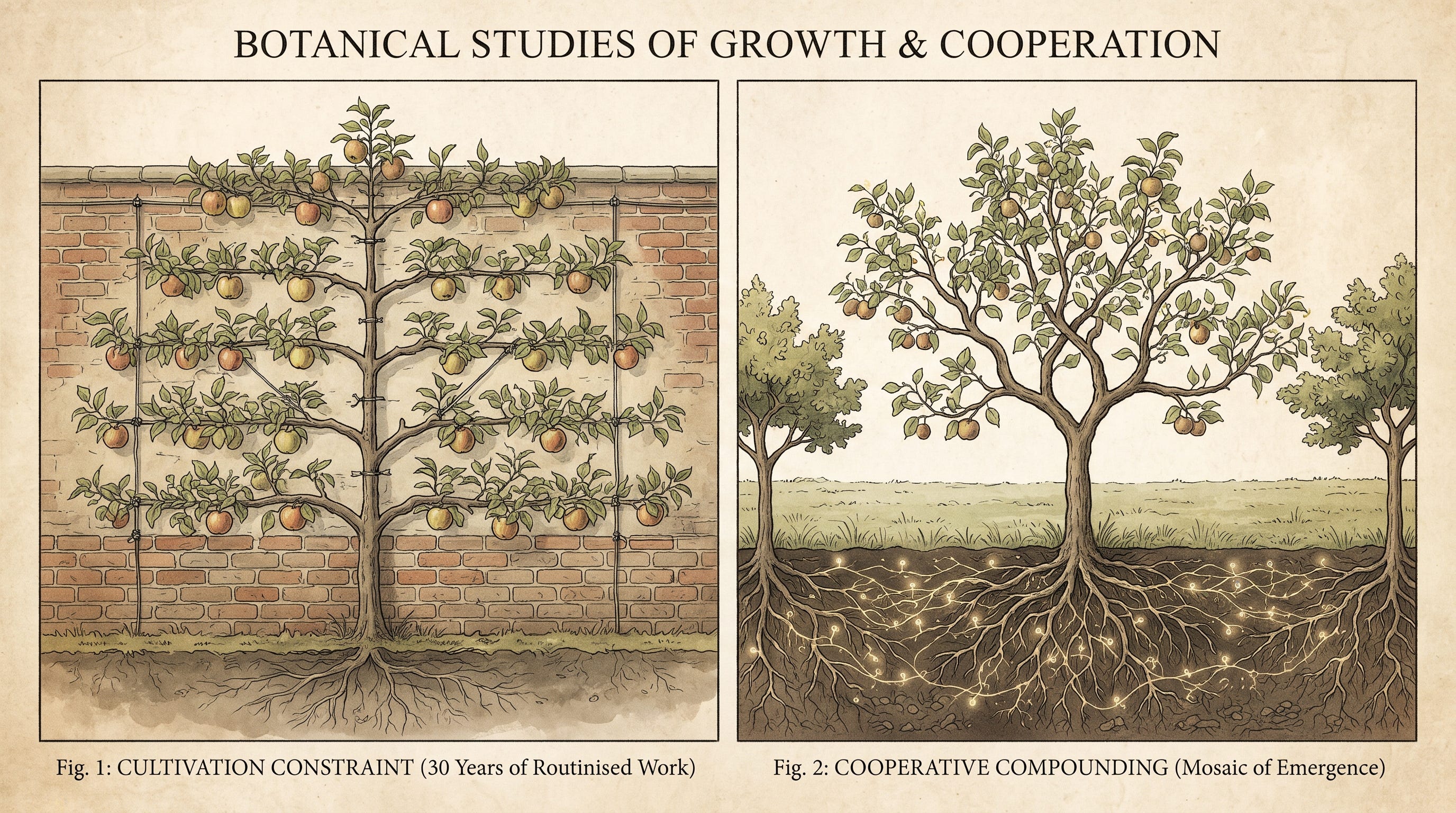
Multi-player mode for organisational programming
Developing a scalable, intelligent agentic enterprise involves solving a lot of problems caused by decades of manual, top-down people and process management, and it also requires changes to technical and data architecture. In particular, we expect to see generic SaaS systems of record gradually relegated to the bottom of the stack by a new emerging data and intelligence middleware layer that can host shared agentic services, which local agents in teams and functions can use as building blocks for intelligent workflows.
Andreessen Horowitz recently shared an insightful account of how their portfolio company Databricks hopes to fill this gap, and what its approach means for the future of the firm.
But beyond the technical architecture, building out the agentic enterprise is less a coding exercise than it is an example of intent realisation — or what we are calling organisational programming. That might sound simple — knowing what you want to achieve and defining in plain language how to do so - but for teams where autonomy and critical thinking have been sucked out of the operating model, it is much harder than it looks.
We have been spending a lot of time working with key support functions in large organisations, using a mixture of action learning, service design and consulting to help them reimagine their work and define the agentic skills, roles, architecture, context, guardrails and escalation paths needed to bring intelligent automation to bear on brittle, manual, complex processes. The reactions we see are fascinating, from teams that struggle to even define basic process flows because they cannot untangle the spaghetti (and have perhaps not been afforded the autonomy needed to fix it) to teams who have breakthrough realisations about what new things become possible once they master the basics. It is some of the highest ROI work we have ever done, and we are learning as fast as the people we are supporting in this work.
This work has really brought home to us just how important it is to empower the people doing the work to design and maintain the operating model they use to do it. Guiding this process successfully requires good old-fashioned collaboration and sharing, rather than lots of people heads-down vibe coding their own agents.
Preparing for the agentic enterprise poses all kinds of challenges for management in large organisations, but alongside learning, training, tool adoption and other basic enablers, the two most important changes go hand in hand:
allow people to think outside the ‘process’ box and reimagine the work needed to achieve their goals, both individually and collectively; and
encourage people to operate more collaboratively with agents, including how they supervise and guide them
Organisational programming builds on existing knowledge in a way that feels very much like it is compounding human intelligence, as opposed to just packaging it for agents.
The practices and disciplines needed to make this work in agentic software development are already widely discussed and analysed, such as this breakdown of loop engineering published by O’Reilly Radar last week. The same kinds of approaches and methods also apply to workflow and work design in organisations, and if we want to engage multi-player mode to accelerate this emerging area of organisational development, then we will need to target the kind of supercooperation cited by the DeepMind Institute essay.
Also, as we have argued previously, we should move beyond simplistic human-in-the-loop supervision towards groups-in-the-loop oversight, where teams guide agents together and compound what they learn.
So the future of agentic AI in the enterprise needs a lot more work on the human factors and collaborative design than we might imagine.
The firms that compound intelligence fastest won’t be the ones with the best models, but those that give people back the discretion to redesign their own work, and the forums and tools to do it together.