


With Lee away this week, on a well-deserved break from thinking about anything to do with AI, I thought I’d use this opportunity to share some of the developments that have caught my attention recently. They cover quite different territory, from the changing boundaries of professional roles to employee agency, organisational knowledge, leaders’ judgement and how we measure the value of AI.
What interests me is that each, in its own way, challenges some of our long-held assumptions about how organisations work. And as AI becomes more capable, those assumptions are becoming increasingly important to question.
When job descriptions stop describing the work
One of the more interesting findings from Gartner’s latest CIO research is that only 4% of surveyed CIOs have explicit plans to redesign roles for a human–agent workforce. Yet organisations with such plans were 2.4 times more likely to be among Gartner’s high-performing AI cohort. The finding is an association rather than proof that workforce redesign causes better results, but the underlying idea is worth exploring.
We often think about AI’s impact on jobs in terms of which tasks can be automated, how much time might be saved, or whether particular roles will disappear. But what if AI changes the boundaries between jobs before it changes the number of jobs?
Gartner gives the example of designers increasingly undertaking testing activities, and testers participating in design. Similar possibilities exist across many professional disciplines. This has implications well beyond job descriptions. Our approaches to recruitment, professional development, career progression and team structures are largely built around relatively stable definitions of roles.
We’ve been exploring the potential of capability-based organisational design for years, where we start with the outcomes an organisation needs to achieve and work backwards to the capabilities, people and technologies required to deliver them.
AI makes that approach increasingly relevant. Rather than simply adding AI to existing jobs, we have an opportunity to reconsider how work is distributed and how teams combine human expertise with machine capabilities.
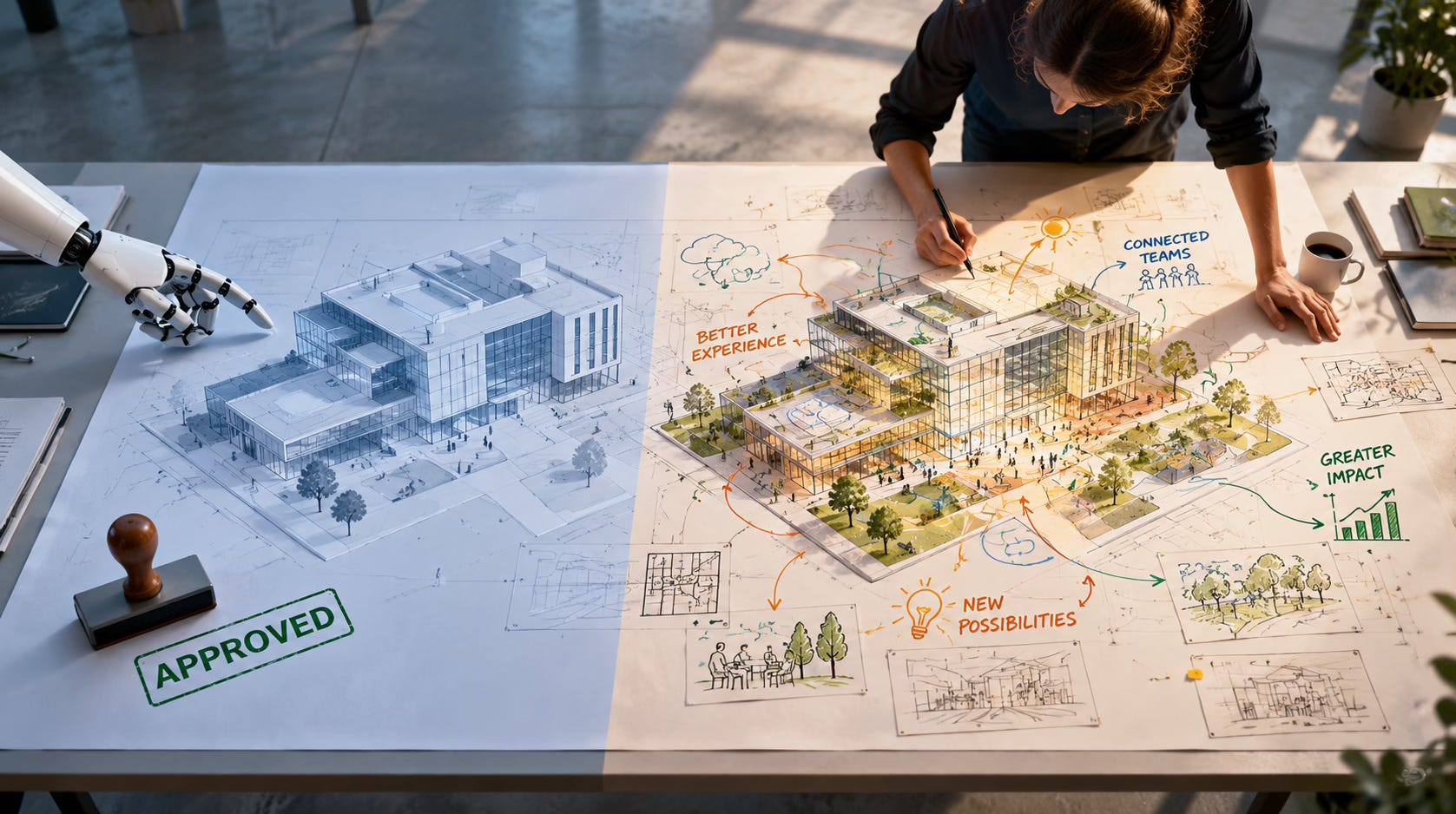
A key question is how we preserve and develop deep professional expertise whilst making the boundaries between roles more fluid.
Agency matters more than agents
Charter’s new AI Pulse research is interesting reading for anyone involved in AI adoption and organisational change. Based on a survey of more than 5,000 US workers, managers and executives who already use AI, it found that one of the strongest factors associated with people benefiting from AI was not technical sophistication or the ability to build agents. It was agency: put simply, having influence over how AI fits into their work.
The research also found that eleven of the fourteen factors most strongly associated with benefiting from AI related to managerial behaviour. Yet managers were roughly twice as likely to report providing helpful support as employees were to recognise receiving it.
Organisations often approach AI adoption as something to deliver to employees. We provide access, training, policies and use cases, then measure engagement and usage. These things matter, but they don’t necessarily give people meaningful influence over how their work changes.
There is an important difference between helping someone use AI within an existing workflow and enabling them to participate in redesigning that workflow. The latter creates opportunities for people to bring their professional judgement, experience and understanding of the work into the design process. It also allows learning to happen through experimentation, rather than treating training as something that must be completed before change begins.
It also raises an uncomfortable question for leaders: are we genuinely creating the conditions for people to shape how AI changes their work, or simply encouraging them to adopt decisions already made elsewhere?
When leaders trust AI more than themselves
The same research also found that executives were approximately twice as likely as employees to report trusting AI over their own judgement, and more than twice as likely to trust it over a knowledgeable colleague. Around one in five executives also reported regularly using AI outputs about which they had doubts.
These are self-reported behaviours rather than direct measures of decision quality, but they raise some interesting questions about how AI changes the exercise of professional judgement, particularly at senior levels.
Much of the discussion about executive AI literacy has focused on helping leaders understand the technology, recognise opportunities and make informed investment decisions. But we perhaps need to pay equal attention to how leaders use AI in their own thinking and decision-making.
There is enormous value in using AI to explore alternatives, challenge assumptions and consider perspectives we might otherwise overlook. But there is also a difference between using AI to improve our judgement and allowing it to quietly substitute for that judgement.
This becomes particularly important as AI outputs grow more sophisticated and persuasive. A well-structured recommendation can feel authoritative even when the underlying reasoning is incomplete or the context is poorly understood.
When organisational conversations become infrastructure
Two announcements on the same day caught my attention because they approach a similar problem from different directions.
Zoom introduced its Unified Context Layer, designed to connect information from meetings, calls and chats with documents and business systems. Meanwhile, Neo4j announced its Context Engine, which aims to provide shared business knowledge, relationships and memory for AI agents.
Most organisations have a considerable gap between what is formally documented and what people actually know about how work gets done.
Policies, process documents and systems of record contain important information. But much of the knowledge that makes an organisation function exists in conversations: why a decision was made, which exception was agreed, what a customer really needs, or why a team has changed its approach.
As AI agents become involved in more complex work, access to this operational context becomes increasingly important. An agent that understands the formal procurement process but knows nothing about a recent supplier negotiation or an agreed exception may have only part of the information it needs.
The interesting possibility is that organisational context becomes a shared capability, continuously developed and maintained, rather than something reconstructed separately for every AI application.
Of course, capturing conversations is not the same as creating trustworthy knowledge. We need to distinguish what was discussed from what was decided, what was authorised and what has actually changed.
This connects closely to something we’ve been exploring in our work on organisational sensing and learning: how everyday activity can contribute to a living understanding of the organisation, rather than disappearing into meeting notes and disconnected documents.
Measuring the work, not the AI
Finally, a recent report on IBM’s deployment of AI agents describes an approach to productivity measurement that many organisations could benefit from.
IBM reportedly has around 6,000 agents operating across more than 150 consulting workflows. But the interesting part isn’t the number of agents. It’s the company’s Productivity Measurement Lab, which compares workflows with and without agents before deployment.
One example involves cybersecurity investigations, where a task previously requiring around 45 minutes of human work reportedly involves 2 minutes of agent activity followed by 10 minutes of human validation. These are company-reported results, but IBM also acknowledges that some agent deployments produce negative productivity.
We are becoming very good at measuring AI activity: tokens consumed, interactions completed, agents deployed and minutes apparently saved. But none of those measures necessarily tells us whether the work has improved.
A faster task might introduce additional review, rework or downstream problems. An agent might complete an activity efficiently whilst making the wider process less effective. Conversely, a workflow might take just as long but produce substantially better decisions, fewer errors or a better experience for the people involved.
The unit of measurement needs to be the whole human–AI workflow, not simply the performance of an individual tool or agent.
I also think there is an opportunity to go further. Rather than comparing only the current workflow with an automated version, we could experiment with different ways of distributing work between people and agents.
That turns AI adoption into a much more interesting organisational design exercise, where we test alternatives, learn from the results and continually improve how work happens.
A question of ambition
One thing that stands out to me about these developments is how familiar many of the underlying organisational questions are. We’ve been discussing professional judgement, employee participation, knowledge sharing and continuous improvement for decades.
What is changing is the extent to which technology can now participate directly in the work itself. That creates opportunities to rethink some long-established assumptions about how organisations function, and makes the choices we make about people, capabilities and the design of work considerably more consequential.
I’ve been struck recently by how often conversations about human-in-the-loop default to the lowest common denominator: a human checking an AI output before it moves on. Both the IBM example, where human involvement is measured in minutes of validation, and Charter’s findings about executives trusting AI over their own judgement illustrate why this matters. In each case, there is an opportunity to think more ambitiously about how AI can develop and extend human expertise, rather than simply shifting work from people to machines.
As we redesign work around AI, are we being ambitious enough about what the human contribution could become?