


Think about the last time you joined a new organisation. Not the formal onboarding process or the HR paperwork, but how long it took before you genuinely understood how things worked. Who knows what they are talking about? Which teams influence decisions? Where to find previous work? How to navigate approvals? Who to ask when something unexpected happens?
For many people, this takes months to acquire, sometimes years. This is curious when you consider how quickly we learn to navigate almost everything else.

Most people can become comfortable using a new digital service within minutes. Whether using Spotify, Google Maps, or an online retailer, the underlying complexity is hidden behind an interface designed to help us find what we need. Organisations are different. Despite decades of investment in digital transformation, knowledge management, and collaboration platforms, the experience of navigating a large organisation remains surprisingly manual. People still rely on personal networks, accumulated experience, and knowing the right person at the right time, not because organisations lack capability, but because much of that capability remains difficult to discover and difficult to access.
What if the next frontier of organisational design is not creating more capability, but making existing capability dramatically easier to access? For most of organisational history, that question had no satisfying answer. That is starting to change.
We Improved Software UX But Neglected Organisational UX
Over the past three decades, one of the great success stories of the digital age has been user experience design. Early software required training courses, specialist knowledge, and thick instruction manuals. As digital products became more competitive, this changed. Complexity disappeared behind experiences designed around user intent rather than system architecture.
Yet organisations evolved differently. As they grew, they accumulated processes, functions, governance structures, and specialist expertise. These investments created real value, organisations became more capable, more efficient, more compliant. But the effort focused overwhelmingly on creating capability rather than making it easier to access.
Many organisations now possess extraordinary internal capabilities: specialist teams, sophisticated processes, vast knowledge, mature governance, and years of accumulated experience. Yet employees frequently struggle to discover what is available, understand how to access it, or navigate the pathways needed to get things done. In software, we learned that capability alone is not enough. Powerful systems fail when people cannot easily use them. User experience became the discipline that bridged this gap. Organisations face a similar challenge and have largely not yet met it.
The Hidden Cost of Complexity
Capability and accessibility are not the same thing. An organisation may contain exactly the expertise required to solve a problem, but the people facing that problem may have no practical way of finding it. It may have documented a process, but people remain uncertain which version applies. It may have solved a problem before, but teams unknowingly solve it again. The capability exists. The experience of accessing it remains difficult.
This gap creates three recurring friction points that compound as organisations grow.
The first is navigation: the capability discovery problem. Most organisations invest heavily in creating expertise, yet comparatively little attention goes to helping people find it. Navigation becomes dependent on personal networks and accumulated experience. Long-serving employees know who to contact and where knowledge lives. Newer employees rely on asking around or stumbling across useful information by chance. The result: teams duplicate work, problems take longer to solve, and valuable knowledge never reaches the people who could use it.
The second is coordination: the capability flow problem. Most organisational work no longer happens within a single team. Delivering a new product or implementing a strategic initiative requires contributions from multiple disciplines and specialist groups. The challenge is rarely a lack of expertise; more often, it is connecting expertise effectively. Teams become increasingly productive, yet organisational progress fails to keep pace. A team can be highly productive whilst remaining poorly connected, valuable work created quickly, then delayed by dependencies, handovers, and the difficulty of aligning multiple groups around a shared objective.
The third is memory: the capability retention problem. Organisations often describe themselves as learning organisations, yet many struggle to remember. Projects are repeated because previous lessons cannot be found. Decisions are revisited because the original reasoning has been lost. Experienced employees leave, taking valuable context with them. The issue is not that knowledge disappears; it is that much of it remains trapped within people, teams, and systems that are difficult to access once the immediate need has passed. Organisations generate more knowledge than ever before, yet people often struggle to access the knowledge that matters most.
Together, navigation, coordination, and memory explain why many organisations struggle to convert capability into momentum. The expertise exists. The resources exist. The intent exists. Yet progress slows because capability cannot flow efficiently through the system.
Why AI Changes The Equation
None of these challenges are new. Various attempts have been made to address them - intranets, knowledge management systems, process repositories, service catalogues. These investments often delivered value, but they shared a common characteristic: people still had to navigate the system themselves. They needed to know where to look, which repository was relevant, which process applied. The burden of interpretation remained with the user.
What has changed is the underlying capability of the technology.
Previous tools were essentially sophisticated filing systems. They could store and retrieve information, but only if you already knew roughly where to look and how to ask. Large language models work differently. Trained on vast amounts of text (documents, conversations, explanations, decisions) they understand intent rather than just matching keywords. When someone asks “who has done something like this before?”, the technology can reason about what that question means, connect it to relevant people, projects, or documents, and return something genuinely useful even when the question is loosely formed. The interface shifts from navigation to conversation.
This matters enormously in an organisational context, because most employees most of the time do not know exactly what they are looking for. They know what they are trying to accomplish. The friction has always been the gap between that intent and the structures (repositories, directories, process maps) through which the answer was buried. When that gap closes, the experience of the organisation changes.
“I need to onboard a supplier in Japan.” “Who has experience with this customer?” “What happened the last time we attempted something similar?”
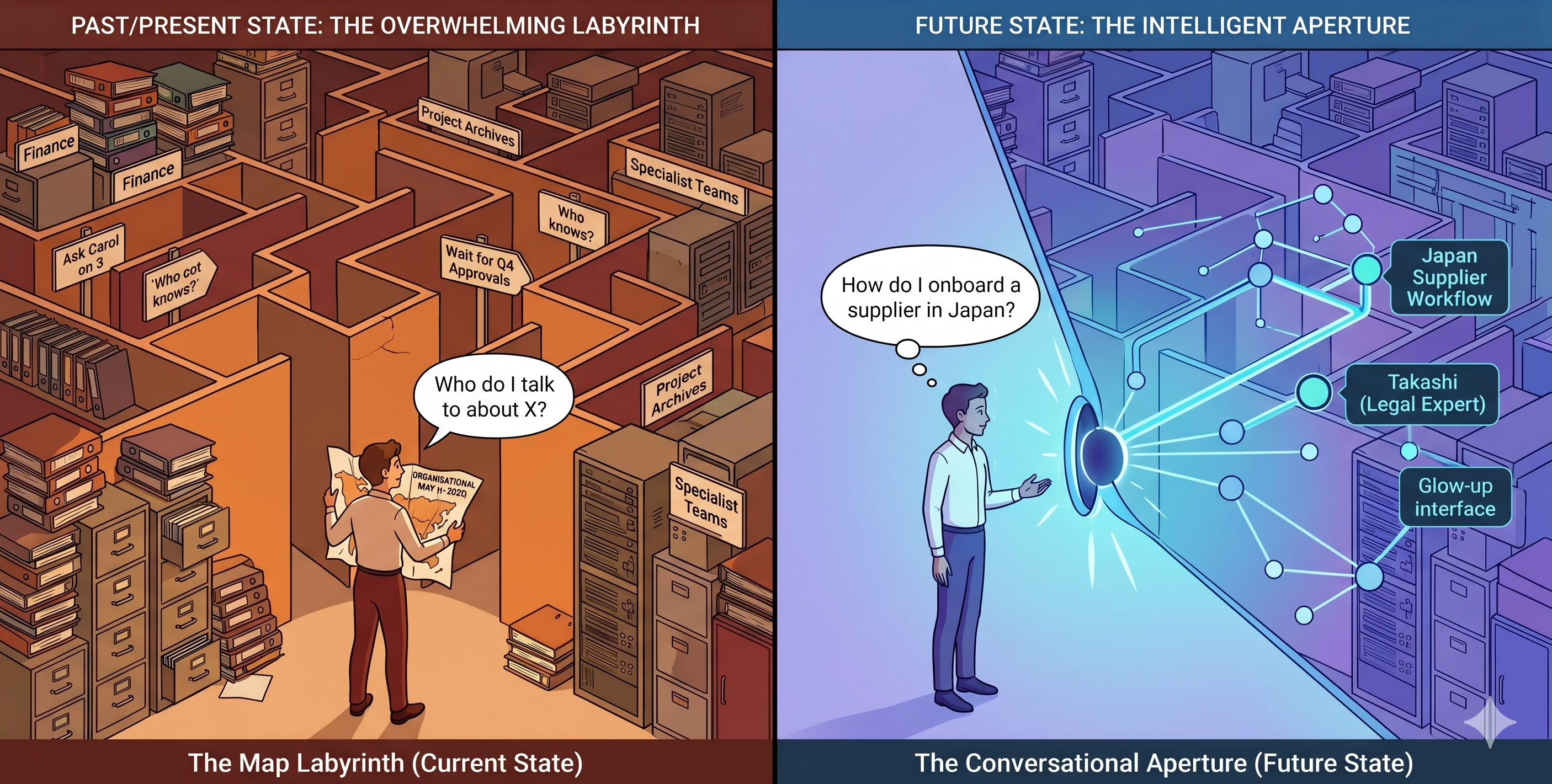
Historically, people adapted themselves to the structure of the organisation. Increasingly, organisations may be able to adapt to the needs of the individual instead. Those familiar with earlier thinking about organisational operating systems or organisation-as-a-platform will recognise this moment. The conceptual frameworks have existed for some time. What was missing was not the vision but the enabling layer, the practical means by which intent could be translated into action without requiring every individual to become an expert navigator of systems they should never have needed to understand. That layer is now arriving.
Capability creates potential. Accessibility creates value.
Read on for some practical steps strategic, operational and transformation leaders can take to make their organisational capabilities more legible, connected and accessible.
