


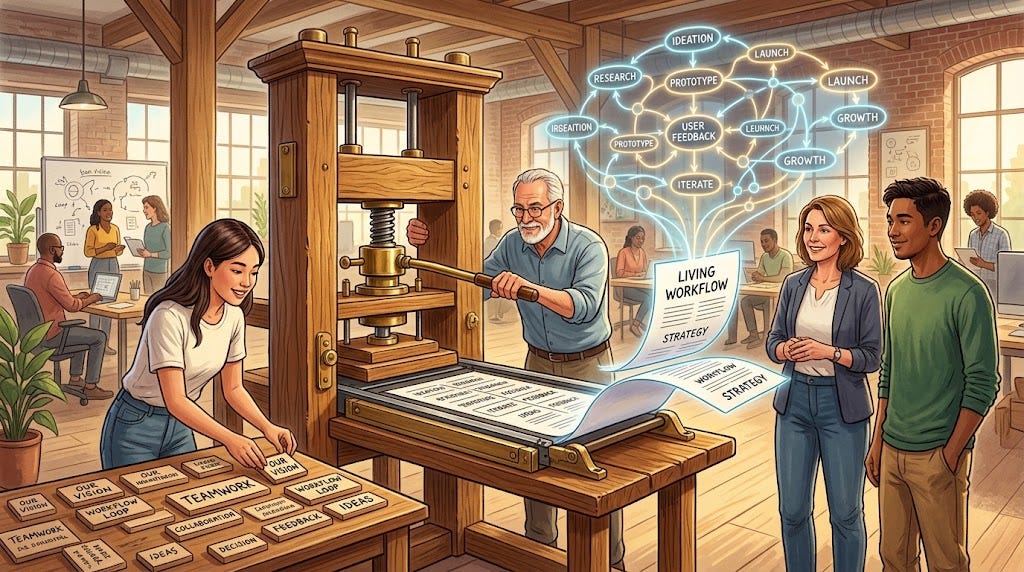
Three developments in agentic AI have recently led to cries of ‘Software is dead!’, both inside and outside the software development profession. But a better conclusion might be ‘Software is free!’ in both the open source sense and more broadly in the sense that it is escaping its priesthood stage and merging into the wonderful ebb and flow of human language and literacy. A Gutenberg moment.
Organisations are already a form of human software for collective action and coordination - they just don’t know it yet. Organisational programming is no longer about writing code, but expressing intent and defining the architecture of how work flows and value is created.
This next shift could create an incredible wave of creative potential as we discover more powerful ways to orchestrate value creation than those we took for granted in the era of bureaucratic management and control. In the short term, this will change the relationship that companies have with software vendors, but longer term it will make software an invisible part of the organisational fabric that underpins our work.
Personal Agents on the March
In consumer AI, there is a marked shift away from interactive, session-based chatbots to always-on, action-oriented personal AI agents. Meta’s Muse along with competitors such as Instinct, Grok Bot, and OpenAI Dots point to a rapidly increasing market for personal shoppers, assistants, planners and other agentic use cases. The mode of action is moving towards persistent, asynchronous agents with long-term memory and significant delegation of rights to use browsers, computer vision, web scrapers and even voice calls and online bookings to get things done.
Stripe CEO Patrick Collison had some interesting things to say about what this might mean for business, how this could help strong niche products become more findable, and also level the playing field between companies and customers by reducing information asymmetries:
Companies are in some sense the original superintelligence. It’s often the case that they can use their amortized cognitive surplus to advance their interests against those of certain consumers: relative to the optimization capacity of companies, consumers can be inattentive, underinformed, irrational, etc. (Think, say, of some of the classic insurance upsells at the end of a booking process, which is typically priced substantially above what a regular policy would cost.) Herbert Simon introduced the idea of bounded rationality, and firms often end up benefiting from it. Thanks to personal agents, we will probably get somewhat more rational in how we engage with companies.
This sounds positive, but could also pose immense challenges to behind-the-curve corporate systems in customer-facing functions if the personal agents get creative in pursuing the goals of their owners too aggressively.
Ethan Mollick also recently wrote about personal agents, acknowledging that he had under-estimated the speed of adoption for autonomous agents that didn’t rely on human managers overseeing every step, which he and others are calling the bitter lesson:
I fell prey to The Bitter Lesson, the hard truth, learned over and over again, that things that we thought required elaborate human rules and thinking can be solved with the brute force of better machine learning systems and more AI.
This lesson is being learned over and over again in relation to providing context, planning tasks, and prompting AI agents, all of which it seems they can do relatively successfully for themselves in many cases … including writing, designing and performing Ethan’s AI video explainer on the topic below.
Software Moats Disappearing?
We are also starting to see major, established and lucrative software categories challenged by agentic coding and reverse engineering.
Adobe’s Creative Suite of tools has been a very visible example of the switch from buying to renting licenses for high value software, and given its high price and tight usage restrictions, it is no surprise that it was a prime target for replacement by AI.
ArtCraft is a small open source project that managed to basically clone the Creative Suite by reverse engineering rather than code theft. The resulting Photoshop clone, PhotoCraft, is cross-platform and open source, which poses a significant threat to Adobe’s much-criticised business model.
Design Week have a piece unpacking the implications for Adobe users and also for software developers, but the technical detail of how this was achieved is also quite fascinating and points to the power of agentic AI to perform complex operations in a short space of time by using tools like Reverse Engineer Anything.
ArtCraft used AI-assisted decompilation & behavioural translation, rather than just manually decompiling the software’s codebase, using LLMs to parse compiled x86 binaries, analyse application behaviour, and translate execution logic into modern Rust code. Adobe’s proprietary source code didn’t need to be leaked or hacked to achieve this.
If agents can reverse engineer anything by watching it work, then the software industry has no technical moat outside of proprietary data, processes or other embedded IP.
Enterprise SaaS Fighting for a Foothold
There has also been a lot of debate recently about the continued reliance on expensive, inflexible SaaS platforms in the enterprise. Some argue these platforms will die out much like Photoshop is threatened by projects like ArtCraft. Others argue they will persist because companies have tied their own workflows so tightly to these platforms that ripping them out is hard. In the middle are those who argue that the platforms will continue as systems of record, but more as headless systems where employees are not exposed to their awful user experience, in effect using them more as glorified databases and process systems accessed via AI agents and API calls.
But in the past few weeks, some leading firms have come out fighting, wrapping themselves in AI use cases and trying to own parts of the enterprise transformation agenda to retain their foothold in the future.
Microsoft’s Satya Nadella has written and spoken about turning Copilot into an operating system for work, which will enable users to access other systems and platforms in precisely the kind of headless fashion mentioned above. The company is also working hard to develop a managed context layer above the models, and also a safe container system for agents to operate with tightly bounded autonomy.
Elsewhere, Celonis wants to own process intelligence and discovery, and help eliminate any ghost processes that might be hanging around, whilst ServiceNow is claiming slightly higher ground as the AI workflow factory.
Meanwhile, Atlassian might be a good bet for a suite of products that could help companies develop and manage their own agentic operating system, with the advantage that they are already well-positioned with software teams and workflows at a time when the whole organisation need to operate more along these lines. Confluence is already a good choice for a connected knowledge platform for context development. Now they are claiming to have the best context graph to sit on top, and are developing an Agentic Multi-player Protocol to help people and agents collaborate effectively.
Organisational Programming Elevates Human Work
Making intelligent platforms that adapt to us, rather than the other way around, is key to elevating the human role in the design of work, and encouraging people to think like organisational programmers and architects. But this skillset has atrophied over the years by treating people as machine operators rather than managers of outcomes. If we apply agentic intelligence judiciously and preserve the role of human judgement in governance, guidance and context engineering, then we will elevate those roles to a higher level, just as we are seeing with software developers, who are the canaries in the coal mine for this shift.
Robert Englander recently published a good argument about why The Future of Software May Be Conversational Rather Than Autonomous, arguing that we are so focused on agentifying software that we are missing the other related shift, which is conversational interfaces and using intelligent systems to make software that adapts to our needs, rather than the other way around.
Serial entrepreneur David Marcus, who was involved with Meta’s agent journey, similarly talks about these shifts in terms of the death of the software interface, but is more bullish on agents being given the freedom to act on our behalf:
For over 40 years, we’ve been learning to speak the computer’s language: coding, menus, forms, dropdowns, the hamburger icon, the “are you sure?” pop-up. We got so used to it that we forgot we were the ones doing the translating. Now the computers speak our language.
That changes what we call an operating system. Today, an OS is mostly a launcher for apps, and whoever owns the launcher sets the rules for everything downstream. When people stop launching apps, the operating system becomes the agent they talk to, and nobody owns that yet.
The potential benefits of these trends for AI-led enterprise transformation are huge. Ultimately, the organisational operating systems that complex organisations use to connect and coordinate their work will be highly customised to their specific value chain and requirements, and intelligent and adaptive enough to evolve themselves.
This is what I think of as organisational programming: expressing intent clearly and imaginatively, and designing the architecture and rulesets that make it real, which become the instructions and specification for the agentic software that runs underneath.
For some companies and governmental organisations, the specific rulesets, the intent and specific ways of working are so central to their IP and competitive advantage, that they will choose to build their own operating system rather than buy or rent platforms to achieve the same goal. Antony Mayfield wrote about the example of the law firm Kirkland & Elliswho are doing just that with a projected budget of $500m, and if you think that sounds like crazy spending to own their own destiny and get a march on the competition, the AI Law Professor breaks down the numbers to show why it makes sense.
At a smaller scale, we will see large companies where the reliance on SaaS platforms reduces over time as they build their own agentic workflows on top, until third party systems are being used only as headless systems and glorified databases, in which case the spend will come into question and they might choose to go all-in on building out their own org OS, perhaps building around existing components in a Microsoft 365 (or other enterprise software) suite.
Knowing what is possible and what is coming down the track, it seems amazing looking back that we have treated so many workers as machine operators required to just press the buttons and fill in forms on cr*ppy SaaS platforms that govern their work processes with very little room for variance. If we can design our way beyond that and focus on building out a modern organisational operating system that we program using plain language, and which can run agentic automation in the background, then we will humanise the enterprise and really get to see what people can do when they are running the show.