


What a time to be alive! In Grand Theft Auto VI (arguably one of the most extraordinary examples of world-building), players now have to do household chores, earn relationship points, and stop at traffic lights, while Washington treats AI industrial policy and export compliance like the protagonist of the 1986 version of Vice City.
Thankfully, the AI investment bubble and associated shenanigans is somewhat disconnected from AI adoption reality, so we can ignore (or enjoy 🍿) the froth whilst we get on with the slow, patient work of making organisations more intelligent and human.
We have been super busy recently with the work of teaching AI literacy and agentic workflow transformation to leaders and managers. One common factor that I find endlessly fascinating is seeing people and teams shift from a process-centric view of their work to a service-centric one. Even where the heavy technology stack that underpins their process landscape cannot be fully reformed or replaced, there is usually so much potential for looking through the other end of the telescope to imagine an ideal service they can offer. And then you can use agentic AI to smooth over the discontinuities, integration gaps and general water carrying to create a substantially improved experience and avoid people having to engage directly with the old SaaS interfaces.
But doing this requires a holistic view of the value chain and process landscape - the why as well as the what - and that is not always easy for people inside such systems to wrap their heads around, at least initially. There might be an idealised process map that people refer to, and typically this will not reflect real practice, which is full of exception handling that is not properly documented. But a bigger gap is the absence of a shared knowledge base, knowledge graph or ontology that both people and agents can reference.
In functions like manufacturing, quality or software and hardware engineering, it is common to find extensive documentation and structured knowledge in the form of wikis or similar platforms. But for many other enterprise functions, knowledge often remains buried in documents that are stored in folders with no clear inter-relationships.
Building that shared knowledge layer may well be the most important readiness work for agentic AI in the enterprise, and the good news is that agents can do much of the heavy lifting.
Knowledge and coherence for AI agents
Twitter and Reddit are bursting with AI solopreneurs who are agentifying their entire lives and businesses, but much of this is bravado and self-promotion that should be taken with a pinch of salt. But in software-adjacent fields and other domains, there are indeed small businesses doing remarkable things with agentic AI and intelligent automation.
Luke Wroblewski recently shared some field notes from an event called Crazy Agent Scale hosted by Sutter Hill Ventures, which give a good insight into the kinds of issues people are facing and how they are seeking to overcome them.
If we compare these examples to the agentic journey of large, established organisations, they are probably equivalent in size and scope to many of the pilots and proofs of concept emerging from individual business functions.
In both fields, one of the biggest challenges is orchestration of multi-agent systems, and this has been identified by several commentators as the principal barrier to scaling pilots in production.
Tristan Gitman, Senior Information Technology Officer at the United Nations, wrote about this challenge last week and explained why better orchestration is key to developing coherence:
Coherence means that hundreds of autonomous decisions, made across several workflows in a single day, are consistent with one another, with the policy in force at that moment, and with the data each agent can actually see.
Mature industries have spent decades building shared standards to keep their records consistent – banks know the exact moment a payment is final, and supply chains rely on a single accurate count of what is in stock. Agentic AI has no equivalent discipline yet.
Long term, we clearly need a better agentic and intelligence middleware layer that sits between systems of record and front-end agentic apps and capabilities. But there is another aspect to this challenge in large organisations, which is a lack of connected knowledge to provide context, inform skills and serve up reliable domain knowledge.
Knowledge factories and agents that dream
In the past two weeks, there has been an explosion of interest in this topic on social media, leading to a lot of articles about knowledge factories, knowledge engines and recursive self-improvement systems for agents.
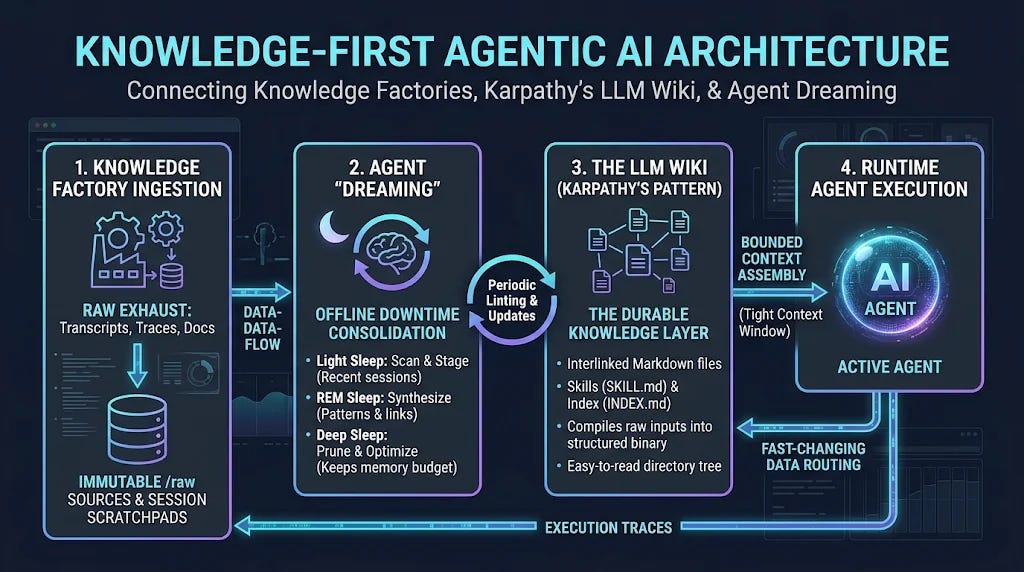
One popular article on this was by Harrison Chase of LangChain, who summarised How to Build a Knowledge Factory for agentic AI in an article that extends the agentic ‘software factory’ metaphor to knowledge.
He writes about three key roles of a knowledge factory:
Skills (”How to do the work”)
Domain Knowledge (”How the business works”)
Data Access Guidance (”Where to get live truth”)
And whereas context is what sits in the agent’s window at runtime, permanent, curated knowledge stores can play a bigger role in maintaining coherence, but also in supporting self-improvement.
The goal isn’t to document everything before agents can start working. It’s to build a system where doing the work reveals what knowledge is missing, and resolving those gaps makes future work better. Start with one recurring workflow, inspect where agents struggle, and close that loop.
We are also seeing the related term knowledge engine, referring to self-improving ontologies and knowledge graphs that provide a navigable semantic layer on top of the documented knowledge.
Elsewhere, in addition to Atlassian, who are positioning themselves as a key player in context management for agentic AI, Notion recently joined the fray with a useful field guide for “building a shared context system that you, your team, and your agents can work in together.”
But here’s the thing: you don’t need to do all this knowledge engineering manually. As Andrej Karpathy’s LLM Wiki project demonstrated, if you establish the basics of the knowledge graph you want to expand upon, and provide sources of reliable internal information, knowledge and documents, AI agents can assemble and curate much of this on your behalf, and also use it to overcome the limits of their own memory and context windows.
For functions whose knowledge still lives in folders of documents, such as HR, finance, procurement or legal, this is the practical place to start. Pick one service people actually use, point an agent at the policies, templates, past cases and email threads behind it, and ask it to build and maintain a simple wiki: what the service is for, how it really works, where the exceptions live and who owns which decisions. Then let the agents that deliver the service work from it, and watch where they stumble. Each gap they hit is a piece of tacit knowledge that previously lived only in someone’s head, and each fix makes both the people and the agents better at the job. That is a knowledge factory at the scale of a single team, and it is far easier to get going than an enterprise ontology programme.
And then, as Anthropic demonstrated earlier this year, knowledge agents can use dreaming to consolidate, distil and organise their understanding during downtime. There is a catch, though. An agent that consolidates its own memory can just as easily turn a bad habit into standing policy, which is why Anthropic has its agents propose memory updates for human review rather than rewriting them silently. Somebody still needs to tend the knowledge garden, and this is a natural job for groups-in-the-loop rather than a lone approver signing off changes one by one.
Recursive self-improvement and ontological profligacy
Recursive self-improvement is already a goal of the frontier AI models, and this idea opens up a world of possibilities, as well as some fears and dangers if misused. The Cosmos Institute recently shared an explainer on the topic, and some musings on what it might be capable of.
But if we combine the simple knowledge-building techniques mentioned above in a local, enterprise context, there could be some simpler, more practical and less risky applications of self-improvement inside organisations.
This pairs well with Venkatesh Rao’s recent chin-scratcher about the profligacy principle as a counterpoint to Occam’s razor. Rather than the default “ontological parsimony” we have grown up with in an era of scarcity, Rao argues we should consider profligacy instead, in an era where we can generate almost infinite scenarios or knowledge multiverses and see what we discover. This reminds me of the famous move 37 that DeepMind’s AlphaGo brought to the ancient game of Go, finding possibilities no human had previously considered.
When we turn out the lights at the end of a working day, maybe our agents can run through a few million hypotheses and scenarios about what to do tomorrow?
Handmade and human
Speaking of pairing, where does this leave us humans if recursive self-improvement is on the horizon and our agents can dream infinite dreams about sales strategies and product innovation?
In a recent newsletter, Azeem Azhar used the phrase The Handmade’s Tale to refer to the wonderfully human things we do and love that are irreplaceable precisely because they are immune to perfection. As an example, he cited the game GTA VI, whose seemingly infinite world of 30k+ in-game characters was made by hand.
My own favourite workplace to study is a fine dining kitchen and front of house team. For me, outside of sports teams or a Formula 1 pit crew, there are few workplaces as wonderfully collaborative and choreographed, producing such glorious and apparently effortless human experiences (notwithstanding the many credible stories of harsh conditions from Anthony Bourdain’s book to Noma). I am in awe of how they work, communicate and coordinate to turn food into art and wine selections into cultural history, and I will happily pay absurd sums to absorb stories about ingredients plucked directly from the sea, or that tiny patch of vines on the slopes of the Serra de São Mamede that produce such memorable Alto Alentejo wines.
I sometimes wonder what on earth these restaurants would do with AI, and it seems like a ridiculous question. Of course they don’t need it. But the point is not to replace human creativity and experience, but rather to handle the boring stuff that needs to be done to sustain and grow the business, which is where many brilliant restaurants fail. Let the chefs be chefs. Let the sommeliers visit obscure producers to find wines that reach their peak years from now. And let AI help with the marketing, promotion, handling enquiries, taxes and any other stuff that the team might not want to do.
Applying the same logic to the workplace, we might find entire sub-regions of process work that are non-core but necessary: the enquiries, approvals, reconciliations and reporting that keep the lights on but rarely make anyone proud. Handing these to agents that draw on a living knowledge base offers more than cost and time savings. It can de-bureaucratise the work further up the value chain, and turn some ostensibly boring support functions from form-filling into sources of operational intelligence and, occasionally, innovation.
That, for me, is the real promise of knowledge factories and agents that dream: the machines carry the water, and the chefs get more time at the stove.