


Most organisations have already lived through one wave of operational consolidation.
At some point, the economics of fragmentation became impossible to ignore. Every business unit managing payroll differently created unnecessary duplication. Every geography developing its own procurement process increased operational inconsistency. Every local support function building bespoke workflows reduced visibility and made governance harder.
The response was the rise of shared services. Finance functions were centralised, HR operations became shared platforms and procurement moved toward standardised operating models. Organisations increasingly recognised that certain forms of operational work were too repetitive and too cross-cutting to be rebuilt independently across the enterprise.
But these central services over-relied on outsourcing and lowest-common-denominator SaaS platforms to manage cost, resulting in poor experiences for employees. In the worst cases, these became bureaucratic power centres that inhibited change and improvement, whilst also handing over control of key strategic functions (employee experience, IT support, etc) to third parties.
Agentic AI may now be creating the conditions for a similarly impactful transition, but one that could right the wrongs of last-generation central services.
Most organisations are still early in the journey, with functions starting to build small operational agents to support onboarding, reporting, approvals, compliance checking, or analysis. Initially, this phase feels highly productive and the barriers to creation are low. Useful systems emerge quickly because local teams understand their own work intimately.
But over time, the same pattern begins to emerge repeatedly:
Different teams build remarkably similar agents.
Operational logic starts diverging between functions.
Context becomes duplicated.
Governance becomes fragmented.
Multiple orchestration layers begin solving the same coordination problems independently.
At first, this duplication is tolerated because experimentation matters more than efficiency. But as adoption accelerates, the primary cost becomes operational incoherence.
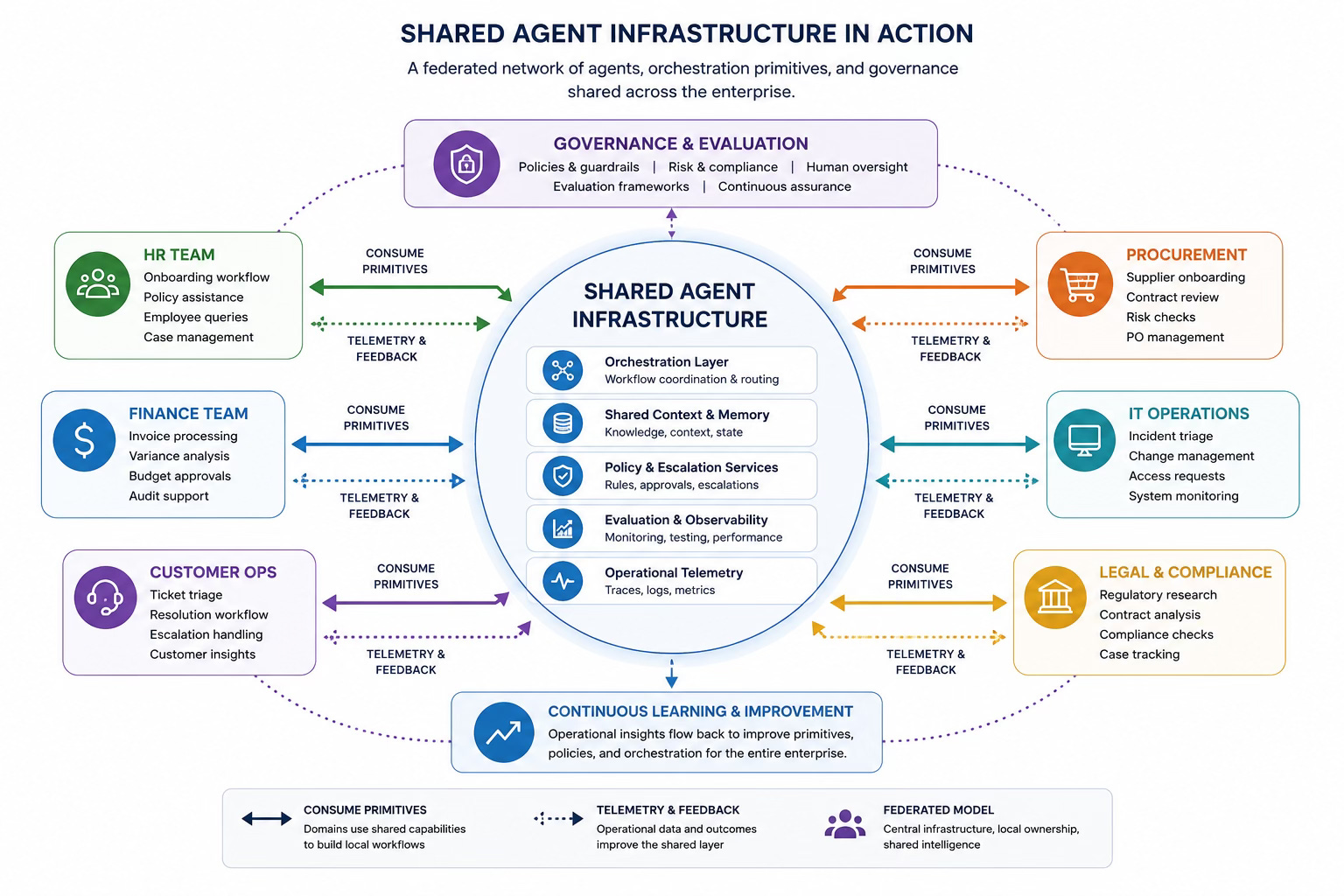
This is where the conversation becomes more interesting. The long-term significance of agentic systems may not lie in the agents themselves, but in the emergence of a new organisational layer sitting beneath them: shared operational intelligence. Reusable layers of orchestration services, shared context infrastructure, operational primitives, evaluation frameworks, and governance capabilities that domains can compose locally without rebuilding repeatedly from scratch.
In effect, organisations may begin creating shared intelligence infrastructure in the same way they once created shared operational infrastructure.
Like all operating model shifts, it immediately raises political questions: who owns orchestration, who governs operational intelligence, what should be shared and what should remain domain-owned, where does infrastructure end and operational judgement begin.
This is the terrain on which enterprise AI adoption may ultimately succeed or fail.
The Return of the Coordination Problem
The moment outputs need to move between teams, functions, approval structures, or governance systems, old coordination constraints begin to reassert themselves. This is partly why so many AI deployments currently feel impressive locally but underwhelming organisationally. The edge accelerates faster than the system holding it together.
Agents intensify this dynamic because they do not simply generate outputs. Increasingly, they participate in workflows by routing work, retrieving information, triggering actions and escalating decisions. Organisations are learning to manage distributed operational behaviours in real-time, and distributed operational behaviours eventually create pressure for standardisation.
The first generation of shared services largely centralised execution. Shared agent infrastructure may evolve differently. Rather than centralising execution itself, organisations may instead centralise reusable coordination capabilities while allowing operational ownership to remain distributed.
That distinction matters enormously - the goal is not for a central AI team to own every workflow. In practice, that would almost certainly fail. But it also makes little sense for every function to independently reinvent identity handling, escalation logic, evaluation frameworks, or orchestration infrastructure.
Over time, some capabilities naturally begin hardening into reusable organisational primitives.
Shared Operational Primitives
Most organisational work contains repeated coordination patterns hidden beneath surface-level variation. Approval routing appears in finance, procurement, HR, legal, and operations. Escalation handling exists across customer service, incident management, and compliance. Classification, verification, prioritisation, and policy interpretation recur across dozens of workflows simultaneously.
Today, many organisations are building these capabilities repeatedly inside disconnected systems. Once agentic adoption matures, that duplication becomes difficult to justify.
It becomes increasingly rational to create trusted, reusable versions of these capabilities that can be composed locally into different workflows. Not in the form of rigid end-to-end processes that we see now in central directives, but modular coordination services embedded into operational infrastructure.
And these modular components may further support re-use by separating the instructional coding (e.g. a ruleset for compliance) from the management of the process (e.g. a compliance checking and verification agent).
This separation matters because it allows organisations to codify operational logic once while reusing it across multiple workflows and domains. A compliance ruleset, for example, may underpin onboarding, procurement, supplier management, customer verification, or incident response without each workflow rebuilding the underlying logic independently. Over time, the value shifts away from isolated automations toward shared organisational codification: reusable operational intelligence that can be orchestrated differently depending on context, risk, and business need.
The most important systems may not be standalone agents visible to users at all. They may instead be shared orchestration layers sitting beneath operational workflows, quietly coordinating information, decisions, escalations, and governance across the organisation. In this model, intelligence becomes partially infrastructural.
Building a Shared Agent Capability
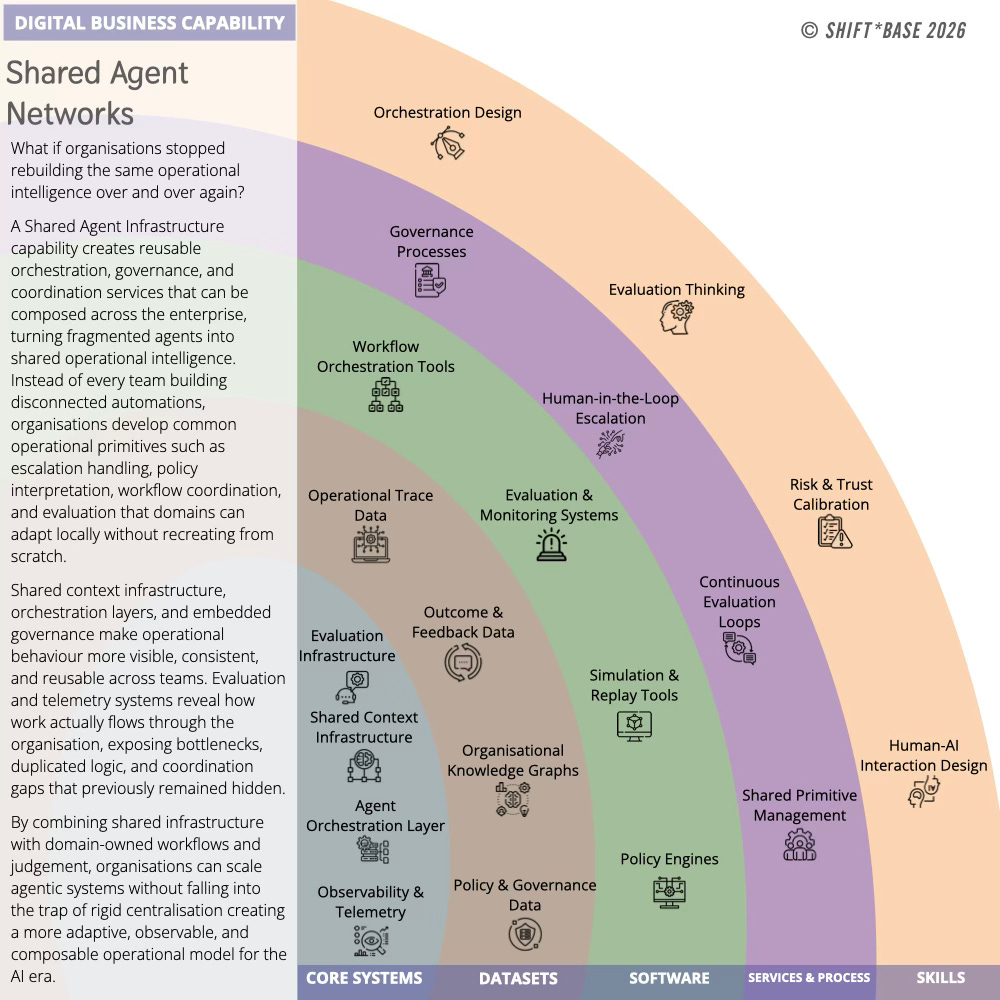
Shared agent infrastructure becomes valuable when it evolves beyond isolated automations into a coordinated organisational capability. That requires designing and integrating five interdependent components:
Core Systems: Agent orchestration layers, shared context infrastructure, evaluation frameworks, observability platforms, and workflow execution engines form the operational backbone for reusable organisational intelligence.
Data Sets: Operational traces, escalation histories, policy repositories, workflow telemetry, and outcome performance data provide the contextual foundation for coordination, governance, and continuous refinement.
Software: Workflow orchestration tools, agent runtimes, policy engines, evaluation systems, and monitoring platforms transform fragmented automations into composable operational capabilities.
Services & Processes: Governance routines, orchestration review processes, escalation pathways, and embedded evaluation loops ensure shared intelligence remains adaptive, trustworthy, and aligned to operational realities.
Skills: Systems thinking, orchestration design, contextual judgement, governance design, and human-AI coordination capabilities enable organisations to balance shared infrastructure with local operational ownership.
The most important skill may ultimately be organisational systems thinking: understanding how operational coordination behaves across teams, workflows, and platforms.
The Political Economy of Shared Agents
Many first-generation shared service programmes failed in ways that are still deeply remembered, because consolidation often stripped too much context away from the work itself. Standardisation hardened into bureaucracy and local teams lost the ability to adapt around edge cases, regional differences, or operational timing. Over time, people started working around the system rather than with it.
There is a real possibility that organisations repeat some version of this pattern as agentic systems mature.
Some layers almost certainly do benefit from becoming shared organisational infrastructure. Identity management, telemetry, observability, evaluation frameworks, policy enforcement, and governance controls all become significantly more valuable when treated as common capabilities. Over time, many of these elements are likely to become as foundational as ERP systems or cloud platforms.
The difficulty is that operational judgement does not behave like infrastructure.
Customer interactions depend on context that cannot easily be standardised. Escalation behaviour differs between domains because the operational consequences of delay, risk, or ambiguity differ. Once these distinctions are flattened too aggressively, organisations end up with systems that appear well-governed while becoming progressively less adaptive in practice.
This is where the emerging boundary between IT and operational leadership becomes particularly important. Agentic systems blur the traditional distinction because operational logic itself becomes executable. The operational model and the technical architecture begin collapsing into one another.
What is starting to emerge instead is something more federated. The objective is to create shared enablement: enough common infrastructure to make intelligence reusable, while preserving enough local ownership for systems to remain adaptive and operationally credible.
Governance as Infrastructure
One of the more important shifts inside shared agent systems is that governance itself begins moving from policy into infrastructure.
In many organisations today, governance remains largely external to execution. Policies are written, review boards are established and oversight happens retrospectively through audits and compliance exercises.
Agentic systems allow governance to become operationalised, so that evaluation can be embedded directly into orchestration layers: escalation pathways can be structured into workflows, logging and telemetry can become default behaviours and deterministic constraints can be placed around probabilistic systems.
This matters because the scale and speed of agentic coordination may quickly exceed the capacity of traditional oversight mechanisms. Shared operational intelligence only becomes viable if organisations can trust how these systems behave across contexts and domains. That trust cannot emerge from policy documents sitting outside the system.
What Shared Agent Infrastructure Makes Visible
One of the most overlooked effects of shared orchestration is visibility.
Most organisations still struggle to see how operational coordination actually happens across the enterprise. Processes disappear into fragmented systems, disconnected workflows, email threads, and local workarounds.
Shared orchestration layers begin exposing these hidden coordination patterns. A customer onboarding journey spanning sales, legal, compliance, finance, and support becomes observable end-to-end. Procurement workflows reveal where escalation loops consistently emerge. Operational bottlenecks become legible not because somebody manually mapped them, but because the orchestration layer generates traces of how coordination actually occurs.
Once coordination becomes visible, it becomes designable. Organisations begin shifting from managing functions independently toward managing the coordination layer between them.
Getting Started
Most organisations do not need to begin by designing a grand enterprise-wide shared agent platform. Trying to centralise too early is often what creates resistance and pushes teams back toward fragmented local workarounds.
A more effective starting point is observational. Look closely at where agents and orchestration are already emerging organically. In most enterprises, teams are already building small pockets of operational intelligence. At first these systems appear isolated, but over time patterns begin repeating. Similar orchestration logic appears across multiple functions. The same coordination problems are solved again and again in slightly different ways.
These repeated patterns are often the earliest signals that shared operational primitives are beginning to emerge naturally. The opportunity is not to immediately standardise every workflow, but to identify which capabilities are becoming infrastructural.
Read on to learn how you can use a loops and layers approach to iterating shared agent networks to make the most of this opportunity without stifling progress.
