


Note: This piece uses project management as a lens to make a broader shift tangible. Much of our recent work has focused on how organisations move from implicit, human-carried coordination toward systems that are codified, legible, composable and coherent. These ideas are often discussed at an architectural level. Here, they are shown in the context where coordination pressure is most visible, allowing the underlying patterns to be observed in practice.
The Hidden World of Projects
Most projects do not fail because the work is unclear, but because alignment cannot be sustained as the work unfolds. Teams generally know what needs to be done, and plans are often internally consistent - the difficulty emerges in how that work is coordinated across time, teams and systems.
We often label coordination as a single activity, but in reality it is the ongoing effort required to keep multiple streams of work moving in a way that remains coherent. This includes managing dependencies between tasks, interpreting whether progress is meaningful or superficial, and maintaining a shared understanding of priorities as conditions change.
These signals exist in every project - task state transitions, message latency, document revisions and shifts in ownership all provide indicators of how work is actually progressing. In practice, these signals are fragmented across tools and interpreted manually. Teams reconstruct the state of the project through meetings, status updates and informal exchanges, often with a lag between what has happened and what is understood.
Most organisations have responded by increasing visibility. Dashboards, trackers and reporting layers provide more information about activity. This improves awareness, but it does not reduce the effort required to interpret that information. Progress is still reconciled manually, dependencies are still tracked unevenly, and alignment remains something that has to be actively maintained, producing a kind of project reporting theatre where the production of slide decks becomes more of a priority than the actual work of the project.
This is where project managers spend most of their time. They act as a coordination layer across fragmented systems and teams, stitching together signals, resolving inconsistencies and intervening when alignment begins to drift. Much of this work is invisible. It does not appear in plans or reports, but it determines whether the system holds together.
As complexity increases, this model begins to break down. More teams, more dependencies and faster cycles of change increase the volume of signals that need to be interpreted. Coordination effort scales with this complexity, and the organisation becomes increasingly dependent on individuals who can absorb ambiguity and maintain coherence under pressure.
Most coordination effort is invisible, and because it is invisible, it is rarely designed or improved.
The Autonomous Project Manager
Once coordination is recognised as the primary constraint, a different question becomes practical. Instead of asking how to improve planning or execution, attention shifts to how coordination itself is maintained and where it breaks down.
In most projects, this breakdown is visible in small, repeated patterns:
Status updates arrive late or require interpretation.
Dependencies are identified, but their impact is not always tracked as conditions change.
Teams report progress locally, while the overall picture remains unclear.
Escalation often depends on someone noticing that something feels off, rather than on a consistent view of risk.
These are not failures of discipline within the project team, they reflect the absence of a system that can continuously interpret what is happening across the project.
Recent advances in agentic AI make it possible to construct such a system. In practical terms, this creates a clear and immediate use case for a project management agent. The coordination work that currently sits with human project managers is already structured enough to be observed, interpreted and partially handled by a system operating across the same tools and signals. Models can now operate with persistent context, observe activity across multiple tools, and act over time rather than in isolated interactions. This allows coordination to be supported directly within the flow of work.
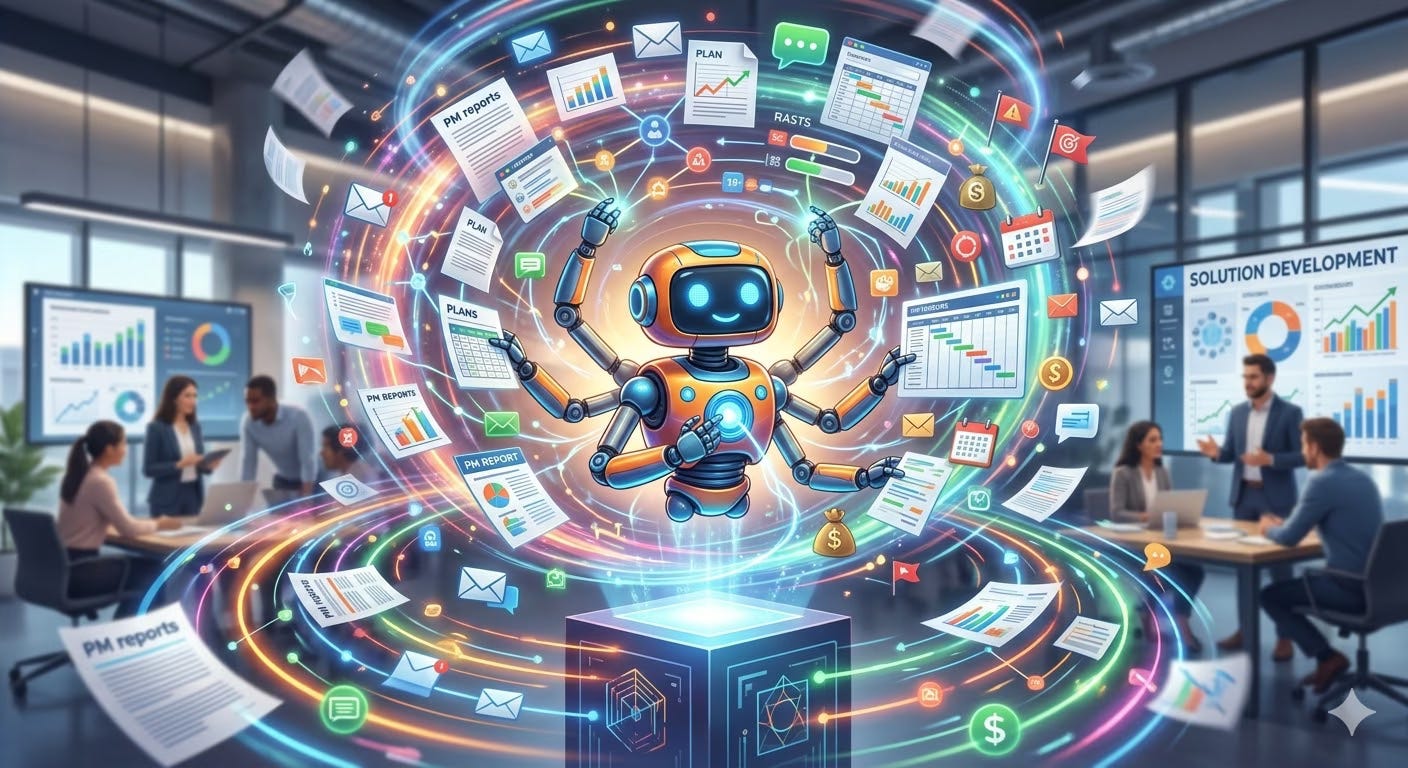
The idea of an autonomous project manager can be understood more concretely as a project management agent that operates across the coordination layer of the work. Rather than replacing the role, this agent takes responsibility for a set of recurring coordination tasks that are currently performed manually. It surfaces what coordination looks like when it is embedded into the system rather than carried by individuals. In practice, this defines a set of responsibilities that can be handled by a project management agent.
The agent continuously assembles a view of progress. Task state changes, document revisions and communication patterns are observed directly, allowing the current state of work to be assembled continuously. The need to reconstruct progress through meetings and reports is reduced.
The agent tracks and updates dependencies as conditions change. When upstream work slips, the effect on downstream tasks can be traced and surfaced early. This reduces the lag between a change occurring and its implications being understood.
The agent generates and distributes updates based on the current state of work. Updates reflect what is happening across the system, rather than relying on periodic summaries that quickly become outdated or inconsistent across audiences.
The agent detects patterns that indicate risk and routes them appropriately. Patterns that indicate risk, such as repeated delays, conflicting signals or gaps in ownership, can be surfaced with context and directed to the appropriate individuals. This reduces reliance on informal escalation through messages and ad hoc discussions.
These changes do not remove the need for coordination. They shift a significant portion of coordination work from manual effort to system support. Activities such as gathering updates, tracking dependencies and maintaining visibility can be handled continuously by the agent, reducing the need for project managers to reconstruct the state of the work.
For project managers, this changes the nature of the role. Time previously spent chasing updates, reconciling information and maintaining visibility can be redirected toward working with stakeholders, resolving trade-offs and shaping solutions as conditions evolve. Less time is spent reconstructing the state of the project, and more time is available to address ambiguity, resolve trade-offs and guide direction.
Coordination moves from something that is repeatedly reconstructed to something that is continuously maintained.
Inside the Coordination System
The patterns described above are already present in most projects. Signals are generated continuously as work progresses, but they are fragmented, delayed and interpreted manually. A coordination capability brings these elements together into a continuous layer that can observe, interpret and respond as conditions change.
The first component is sensing. Every project generates a stream of signals: task state transitions, changes in ownership, message latency between teams, document revisions and dependency updates. These signals exist across tools and communication channels, but they are rarely combined. As a result, no single view reflects the current state of the system. Bringing these signals together allows the project to be observed as it is, rather than as it was last reported.
Interpretation builds on this. Signals on their own do not indicate whether a project is on track - a task moving to “in progress” may represent genuine progress, or it may reflect a delay in starting work. A completed task may unblock downstream activity, or it may mask unresolved issues. Interpretation requires relating signals to outcomes, timelines and dependencies. This allows the system to distinguish between movement and meaningful progress.
Coordination follows from this understanding. Dependencies between workstreams can be treated as active relationships rather than static links in a plan. When upstream work slips, the system can trace the impact across downstream tasks, identifying where timelines need to adjust or where attention is required. This reduces the delay between a change occurring and its consequences being understood.
Communication becomes part of this same layer. Instead of aggregating updates manually, the system can generate views of progress based on current conditions. Different stakeholders require different levels of detail, but the underlying information remains consistent. This reduces the need for parallel reporting structures that often diverge over time.
Escalation provides structure to decision-making. Patterns such as repeated delays, conflicting signals across teams or gaps in ownership can be detected as they emerge. These situations can be surfaced with relevant context and directed to the appropriate individuals. This allows human attention to focus on points of uncertainty, rather than on monitoring routine activity.
These components do not operate independently. They reinforce each other. Better sensing improves interpretation. Clearer interpretation supports more effective coordination. Structured coordination reduces the noise in communication. Consistent communication improves the quality of escalation.
Together, they form an emerging capability that allows alignment to be maintained continuously. The system does not remove variability from the project, but it reduces the effort required to detect, understand and respond to it.
Coordination becomes observable, interpretable and responsive, rather than fragmented and manually reconstructed.
Where Humans Remain Central
A coordination capability changes how effort is distributed across a project, but it does not reduce the need for human judgement. It changes where that judgement is applied and how it is informed.
When coordination is supported as a system, the backward looking reconstruction effort is reduced. Signals are assembled continuously, dependencies are made visible as they evolve, and the state of the project can be observed without manual aggregation. This creates space for attention to shift toward interpretation and decision-making.
Judgement becomes concentrated in areas where signals alone are insufficient. Prioritisation across competing objectives requires an understanding of intent that extends beyond task-level progress. Decisions about whether to absorb a delay, re-sequence work or escalate an issue depend on how outcomes are valued in context.
Ambiguity is another area where human input remains essential. Conflicting signals are common in complex projects. One team may report progress while another experiences blockage. A dependency may appear resolved in one system but remain open in another. Interpreting these situations requires an understanding of how work is actually being carried out, not just how it is represented.
Stakeholder dynamics introduce a further layer. Commitments, expectations and reputational considerations shape how decisions are made. These factors are rarely captured fully in systems, yet they influence how trade-offs are resolved and how issues are communicated.
Escalation, when structured effectively, directs these moments of uncertainty to the appropriate individuals. The system can identify patterns and assemble context, but decisions about how to respond remain with people who carry responsibility for outcomes.
This shifts the role of those involved in project leadership. More time and attention is freed up for shaping intent, resolving uncertainty and making decisions that affect the trajectory of the work.
The Failure Mode: More Activity, Same Misalignment
Introducing a coordination layer does not automatically improve performance and alignment. It can also increase the volume and speed of activity without changing how that activity is interpreted.
This pattern is already familiar. Most organisations have invested in tools that improve visibility, yet still rely on manual effort to reconcile what those signals mean. The result is more information, but not necessarily better alignment.
This leads to a form of coordination that is technically consistent but operationally ineffective. Activity is tracked, updates are generated, and alerts are surfaced, yet the underlying coherence of the work does not improve.
Communication can become a source of friction rather than clarity.
Escalation can place additional strain on decision-makers if it is not well structured.
There is also a tendency to formalise coordination prematurely. Systems that impose rigid workflows can struggle to accommodate how work actually happens. Teams adapt by working around the system, reintroducing informal coordination alongside the formal structure.
These patterns share a common characteristic. The system responds to signals, but does not improve how those signals are interpreted or acted upon. Coordination effort is redistributed, but not reduced.
This is the same failure mode that appeared in earlier waves of automation. Processes became faster and more visible, but remained fragmented. The system optimised activity within existing constraints rather than improving how the work held together.
What are the conditions for success?
When coordination is treated as a capability rather than a role, a different set of requirements becomes visible. These are not new technologies as such, but conditions that determine whether alignment can be sustained systematically.
Clarity of outcomes provides the foundation. The system needs a stable reference point against which progress can be interpreted.
Shared context allows that interpretation to be consistent. Goals, roles, dependencies and constraints need to be visible in a form that can be related to ongoing activity.
Access to systems and data determines the quality of signals available. Work that is dispersed across disconnected tools or constrained by interfaces limits the system’s ability to observe and respond. Coordination relies on the ability to relate activity across environments, rather than treating each system in isolation.
Defined escalation pathways provide boundaries for decision-making. The system needs to know when to surface situations and how to direct them appropriately.
Codified ways of working support continuity. Many coordination patterns already exist within organisations, but they are often informal and unevenly applied. Making these patterns explicit allows them to be observed, adapted and, where appropriate, supported by the system.
These conditions make it possible for coordination to move from an informal practice to a structured capability. They allow alignment to be sustained through the interaction of systems and people, rather than relying on continuous manual intervention.
The effectiveness of coordination depends on how clearly the organisation can represent its own work, context and decision boundaries.
Read on for what this means for the future of the Project Manager role.
