


Over the past two years, enterprise AI has become remarkably accessible - organisations can choose between frontier and open models, purchase enterprise licences in days rather than months, and build prototypes with a speed that would have seemed extraordinary only a short time ago.
But we also see that organisations with access to the same technology are achieving dramatically different results. Some are moving steadily from experimentation into production, deploying AI across multiple teams and creating measurable operational value, whilst others remain caught in an almost continuous cycle of promising pilots, isolated use cases and difficult handovers into the business.
The difference is rarely the model - increasingly, it is not even the platform. Instead, the bottleneck has shifted towards the work that sits between technical possibility and operational reality.
Successful AI deployments almost always require someone to understand how work is really performed, translate that understanding into technical designs, implement solutions quickly, support teams through change, evaluate what happened, and capture the learning so it can be applied again elsewhere. These activities are often distributed across different functions, delivered by external partners or assembled temporarily for individual projects; but they are seldom recognised as a capability in their own right.
What organisations are really building is not AI systems. They are building the organisational capability to repeatedly build and deploy agentic AI systems - in other words, the machine that builds machines. What has often been treated as project delivery or implementation support is starting to look much more like a permanent enterprise transformation capability.
I’m calling this capability AI Operationalisation.
Looking at the capability from the outside in
Organisations often describe new capabilities from the inside out. Conversations begin with platforms, architecture, governance and data before eventually reaching the people expected to make them work. Whilst these foundations are important, they rarely help leaders recognise whether the capability actually exists within their organisation, so we prefer to work in the opposite direction.
Capabilities become visible first through people. They are expressed in the skills individuals develop, the ways teams work together and the routines that repeatedly produce successful outcomes. Only then do we ask what processes support those people, what software enables those processes, what data they depend upon and which core systems provide the underlying infrastructure.
This outside-in perspective is particularly useful for AI Operationalisation because very few organisations are starting from zero. The capability already exists in fragments. Enterprise architects observe work alongside domain experts. Product teams redesign processes with operational leaders. Engineers build solutions whilst change specialists help teams adopt them. Analysts evaluate outcomes and practitioners document what worked so the next deployment starts a little further ahead than the last. These activities form a repeatable organisational capability that translates AI from technical possibility into operational reality.
The Anatomy of AI Operationalisation
AI Operationalisation is not a single role, team or technology. Each component contributes something different, but it is their interaction that allows organisations to repeatedly translate AI potential into measurable operational value.
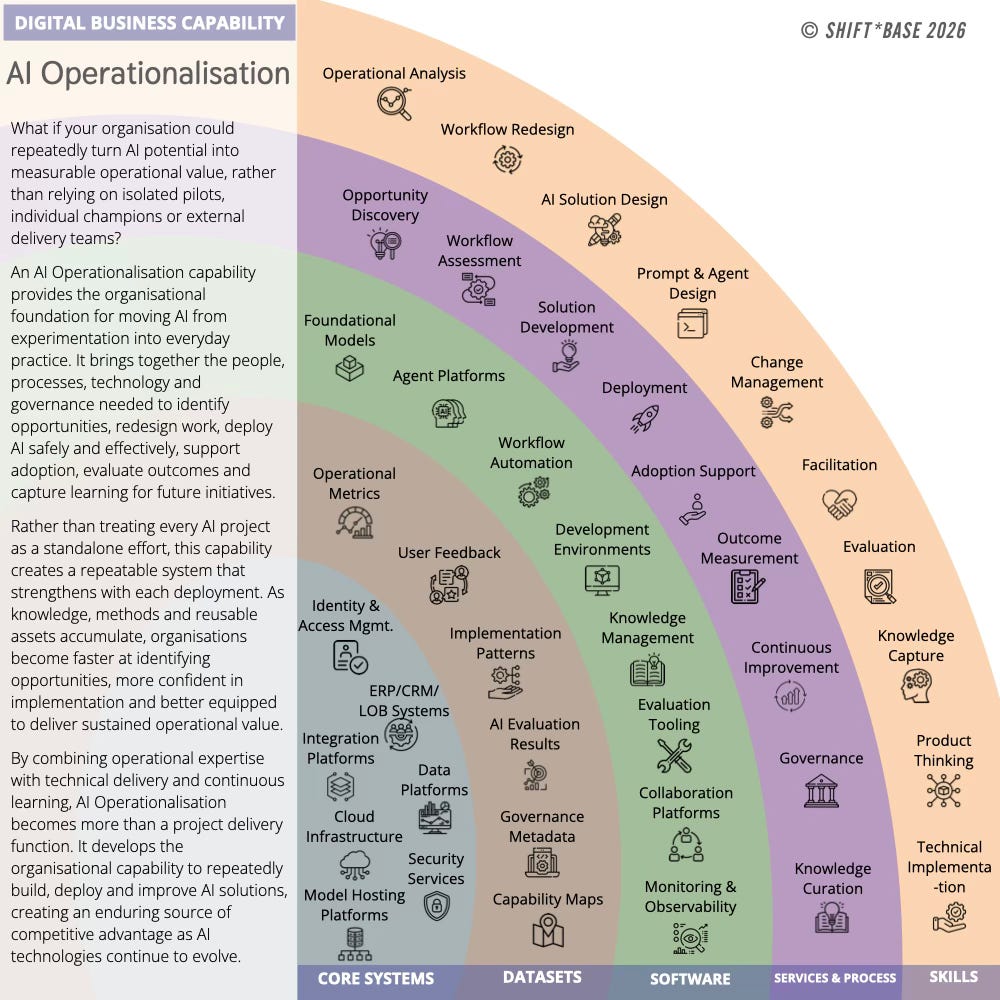
Skills & People: Operationalisation begins with people. It depends on individuals who can observe work as it is really performed, translate operational knowledge into technical designs, guide teams through change and evaluate whether new approaches genuinely improve outcomes. Just as importantly, it requires people who can capture and codify what has been learned so each deployment strengthens the next. These skills bridge the gap between technical possibility and operational reality.
Services & Processes: Operationalisation is sustained through repeatable ways of working. This includes discovering opportunities, prioritising where AI can create value, designing and deploying solutions, supporting adoption, measuring outcomes and capturing learning. Over time, these processes transform isolated implementations into a repeatable organisational capability.
Software: Software provides the tools that enable operationalisation at scale. Development environments, workflow platforms, orchestration frameworks, knowledge systems and evaluation tooling all support the people and processes responsible for turning ideas into operational systems. Rather than defining the capability, they accelerate and reinforce it.
Data: Every deployment generates knowledge. Process observations, operational signals, implementation patterns, performance measures and user feedback all contribute to a growing understanding of what works, what does not and why. This data becomes the foundation for improving future deployments rather than repeating the same learning from scratch.
Core Systems: Finally, operationalisation depends upon the enterprise foundations that allow AI to operate reliably within the organisation. Business applications, integration platforms, identity services, governance mechanisms and infrastructure provide the environment in which solutions can be deployed safely, consistently and at scale. Without these foundations, operationalisation remains fragmented rather than becoming an enterprise capability.
Why this capability is emerging now
Capabilities rarely appear because organisations decide to invent them. They emerge because certain combinations of work prove valuable enough to perform repeatedly. The emergence of AI Operationalisation reflects a broader shift in where organisations are finding the greatest challenge.
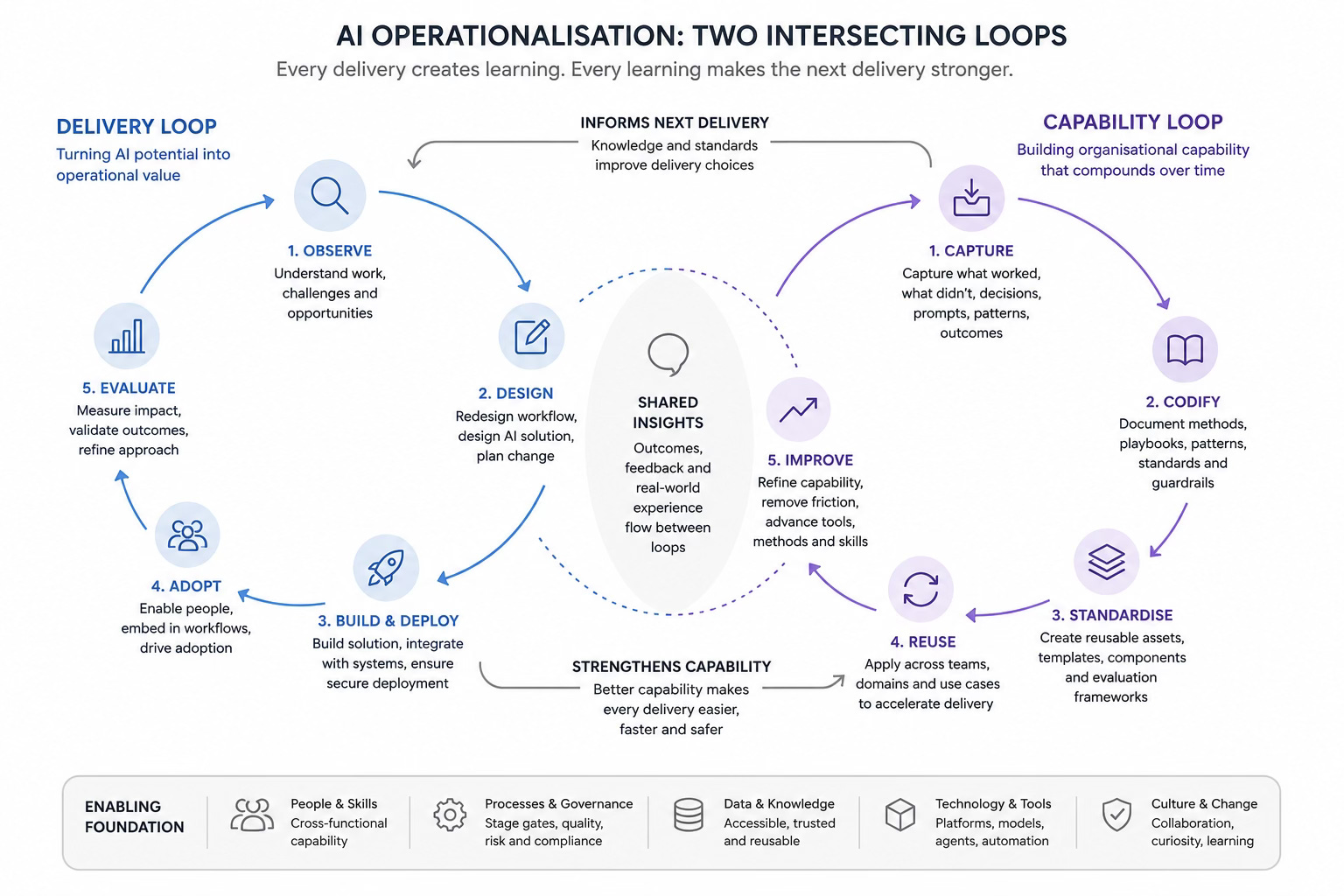
The first phase of enterprise AI was characterised by access. Organisations evaluated models, selected platforms and experimented with new technologies. Success was often measured by the quality of the underlying models or the sophistication of the tools being deployed.
Today, that challenge is becoming increasingly well understood. The harder question is no longer whether AI is capable of performing a task. It is whether organisations are capable of deploying it repeatedly, safely and in ways that deliver measurable operational value.
One of the clearest signals that AI Operationalisation is becoming a recognised capability is the rapid emergence of the Forward Deployed Engineer (FDE).
Originally popularised by companies such as Palantir, the role has since spread across the AI industry. Rather than acting purely as software engineers or consultants, FDEs sit between customer operations and technical implementation. They observe how work is performed, identify opportunities for AI, design solutions alongside operational teams, support deployment and capture learning that informs future implementations.
Whilst organisations may describe these individuals through different job titles, the underlying pattern is remarkably consistent. They combine operational understanding, technical capability and organisational change into a single delivery function.
The important insight, however, is that the Forward Deployed Engineer is only one way of packaging this capability. Organisations should be cautious about assuming the capability belongs to a particular role. As AI adoption matures, these responsibilities are likely to become distributed across architects, product teams, operational leaders, engineers and change practitioners. The enduring asset is not the role itself, but the organisational capability it represents.
The capability itself does not belong to any particular vendor, platform or methodology. It is becoming a fundamental requirement for organisations that want to move beyond isolated AI projects towards sustained operational adoption.
The Loops & Layers of AI Operationalisation
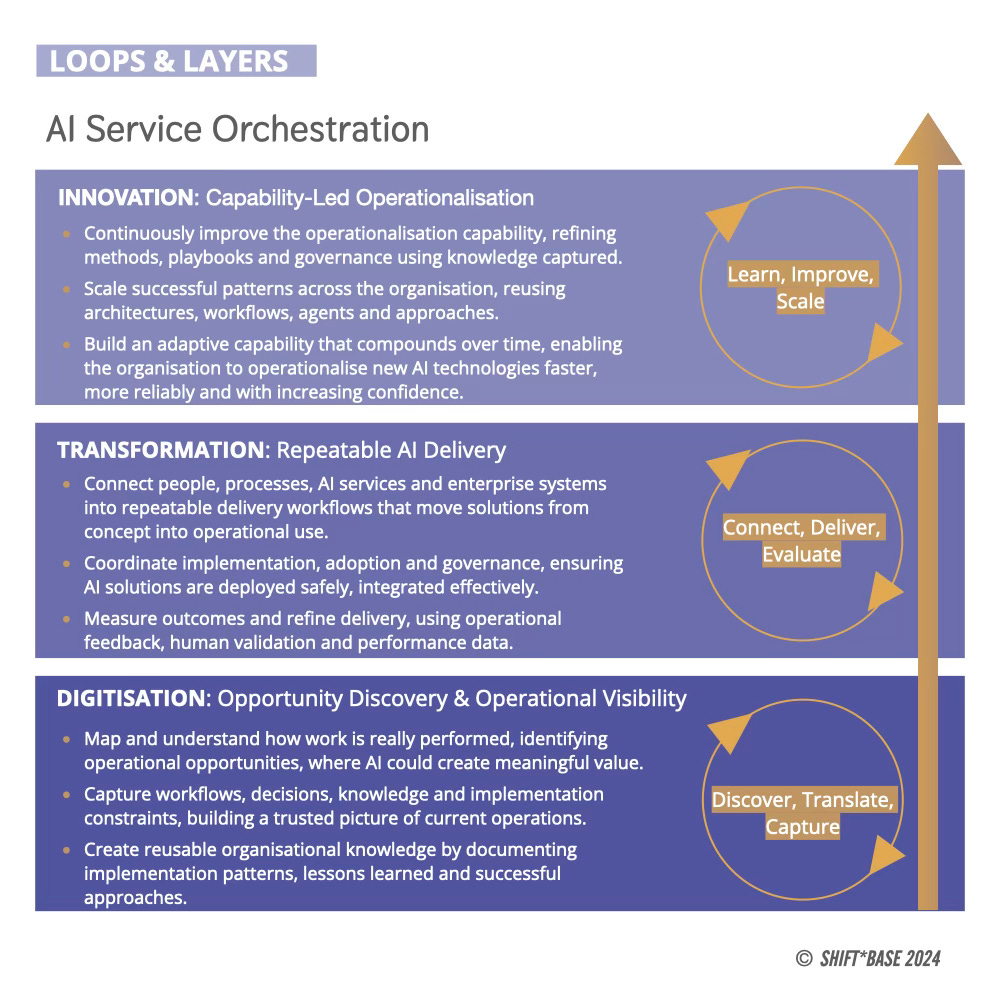
Like any enterprise capability, AI Operationalisation is not built in a single programme or transformation initiative. It develops through repeated cycles of deployment, reflection and refinement. Each implementation strengthens the capability, revealing new knowledge, improving existing practices and increasing the organisation’s ability to operationalise AI again in the future.
This is why we describe capability development through Loops & Layers. Layers represent the broad stages of organisational maturity, whilst loops describe the continuous learning and change that allows organisations to progress between them. The objective is not to reach the most advanced layer as quickly as possible, but to ensure each stage leaves behind stronger organisational capability than the one before it.
Read on to learn how to evolve this capability in your own organisation.
