


More than a decade ago, Gary Hamel neatly captured a problem that organisations still haven’t resolved:
“Right now, your company has 21st-century Internet-enabled business processes, mid-20th-century management processes, all built atop 19th-century management principles.”
This conundrum has endured because successive waves of technology have changed what organisations can do far faster than we have changed the assumptions we rely on to manage them:
the internet connected work that had previously been separated;
social technologies made collaboration possible across organisational boundaries; and,
cloud computing made infrastructure elastic.
Yet much of management remained recognisably built around hierarchy, jobs, headcount, annual planning and the allocation of scarce human resources.
Agentic AI adds a further dimension to that mismatch, at a whole new scale.
UKG recently disclosed that its 14,000 employees have created more than 12,000 AI agents across Microsoft, Gemini and ChatGPT. Alongside them sit 387 internal AI applications, selected from more than 1,400 ideas submitted by employees. And twelve thousand is the number I keep coming back to - not because agents are about to outnumber employees, or because there is something inherently worrying about having that many. It is interesting because of how quickly an entirely new layer of productive capacity can now appear inside an organisation.
Adding human capacity has traditionally been comparatively slow. Someone identifies a need, funding is agreed, a role is defined, recruitment happens, a person joins and gradually develops the context and expertise required to contribute. Even adding technological capacity has usually required some combination of investment decisions, procurement, development, integration and deployment. An employee creating an agent collapses so much of that friction.
One person can create several. An agent can exist for a narrow piece of work, be copied by another team, combine capabilities that previously sat across functions, or disappear when it is no longer useful. Thousands of small decisions about what should be delegated to machines can start changing how work happens without anyone ever sitting down to redesign the organisation. That creates a management problem quite different from the familiar concern about “agent sprawl”.
The question isn’t simply how an organisation governs 12,000 agents. It is how it can understand and actively shape a work system that can now change at a speed its traditional management processes were never designed to accommodate.
We may be approaching an unusual moment in the history of management.
For most of it, productive capacity has been difficult and expensive to add, and many of our management practices evolved around allocating that scarcity.
What happens when some forms of capacity become almost frictionless to create?
A workforce you can create without recruiting
We already have language for some of what is happening. We talk about digital workers, agent workforces and human-machine (or what we describe as centaur) teams. These are useful metaphors, but they can also obscure what is genuinely different about the capacity now appearing inside organisations.
A human workforce has some fairly predictable constraints. People take time to recruit and develop. They have a finite working day. Moving people between teams has consequences. Adding a hundred people to a function is a significant organisational decision that will appear in budgets, workforce plans and, somewhere along the way, in front of a senior leader. None of that is necessarily true of agents.
An employee might create one to help with a recurring piece of analysis this afternoon, another to prepare for a weekly meeting, and a third that monitors something they previously checked manually. A team might create a collection of agents around a workflow. Someone elsewhere might copy one and adapt it for a different purpose. Some will become important pieces of organisational infrastructure; others will be short-lived and disappear.
This makes machine capacity unusually elastic. It can be added, replicated and redirected at a speed that human capacity cannot, increasingly by the people closest to the work rather than through a central technology function.
We have spent years encouraging organisations to distribute digital capability more widely. The citizen developer movement was partly about allowing people closest to a problem to improve the systems around them rather than waiting in an IT queue. Generative AI lowers that barrier again. Creating something capable of participating in the work is becoming an everyday activity.
There is enormous potential in that. A team that understands its own work deeply is often better placed to spot where an agent could remove friction, watch for a signal or take on repetitive coordination than a central transformation team could ever be. But it also means the operating model can begin changing from the edges.
Every time someone delegates a piece of work to an agent, they make a small organisational design decision. They decide that a particular activity can be performed differently, that some knowledge can be encoded, that a decision can be prepared or perhaps made by a machine, or that information can move between parts of the organisation without the human coordination previously required. Individually, most of these decisions may be trivial. Across 12,000 agents, they are not.
This is where the UKG example becomes more interesting than its headline number. If thousands of employees can independently add new capacity and redistribute pieces of work between people and machines, the organisation is continuously modifying the system through which work gets done.
And our existing management machinery has remarkably few ways of seeing that happen. After all, a headcount plan will not show it, an organisation chart will not show it, a job architecture may eventually register that roles have changed, but usually long after the work itself has moved. Even a conventional technology inventory tells us primarily what has been deployed, rather than what has changed in the organisation as a result.
This is why the emerging interest in agent registries is important, but also why a registry cannot be the end point. AWS, for example, has introduced automatic discovery of agents across an organisation alongside information about ownership, access, sharing and cost allocation. This is important infrastructure. Once agent creation becomes distributed, relying on every employee to remember to register what they have built is unlikely to give you a reliable picture.
If twenty teams independently build agents to reconcile information between the same systems, perhaps the interesting signal isn’t duplication. It is that the organisation has a reconciliation problem.
If managers across the business create agents to compile status reports, perhaps the question isn’t how to standardise the best reporting agent. It is whether the management system still needs all those status reports.
And if agents repeatedly appear around the same capability, removing activities that once occupied significant amounts of human time, an even more important question appears:
What are we choosing to do with the capacity they create?
Some duplication will simply be duplication. Some agents will be badly designed, unnecessary or short-lived. But if we rush too quickly to tidy the estate, we risk throwing away useful information about why people created them in the first place. These aren’t reasons to preserve inefficient work. They are reasons to look at the whole system when we change it.
In a previous Shift*Academy piece, I explored why workforce planning increasingly needs to understand where organisational capability resides across people and agents. The speed of distributed agent creation makes that challenge more immediate. The allocation between human and machine capability isn’t only something that will be decided in a workforce plan. Increasingly, it is being altered every day by people making local decisions about what they can delegate.
The organisation therefore needs ways of sensing those changes while they are happening: not so that every local experiment can be centrally controlled, but so leaders can see emerging patterns, understand their consequences and decide where the wider system needs to change.
Because visibility is only useful if we are prepared to act on what it shows us.
The temptation to manage everything like compute
This brings us back to the question of what happens to the capacity agents create. There is an obvious answer: we use it to produce more.
Sometimes that will be exactly the right choice. A customer service team facing rising demand might use agents to handle more enquiries. A finance function might shorten a reporting cycle. An engineering team might investigate more options before making a decision. Greater productive capacity is valuable precisely because it allows organisations to do things they could not previously do.
The problem comes if increased output becomes the automatic answer.
Machine capacity lends itself particularly well to optimisation. We can measure tokens, cost, throughput, latency, utilisation, accuracy and the number of tasks completed. We can compare agents, improve them and redirect their capacity. As agents become a larger part of the operating system, organisations will inevitably become better at understanding the economics of that machine capacity.
People will be working inside the same system, but it would be a mistake to manage them according to the same logic.
If an agent gives someone five hours back each week, it is easy to treat those five hours as newly available capacity and fill them immediately. Five hours becomes more cases processed, more customers contacted, another project added or a smaller team expected to produce the same output.
Repeat that cycle often enough and AI could make an organisation dramatically more productive without making work noticeably better for the people inside it. It might even make work worse: every efficiency gain removing another pocket of breathing space until human attention is concentrated almost entirely on the difficult, ambiguous and emotionally demanding work machines cannot perform.
That would be a peculiar outcome from technologies we frequently describe as augmenting human potential.
Capacity released from routine work could create more time to understand customers, develop expertise, coach a colleague, investigate an unusual problem, experiment with a better approach or simply think before acting. Some of it might be deliberately retained as slack, giving teams greater ability to respond when something unexpected happens rather than operating permanently at the edge of their available capacity.
This doesn’t mean productivity no longer matters. It means productivity becomes an input into a wider management decision about what we want the work system to produce and what capabilities we want it to grow.
There is an important difference between optimising machine capacity and developing human capacity. An agent can be run closer to its limits, replicated when demand increases and retired when its usefulness declines. Human capacity grows through experience, learning, relationships, autonomy, challenge and sometimes having enough space to notice something that wasn’t on the task list.
This is where Hamel’s old observation acquires a new edge.
We could build extraordinarily sophisticated 21st-century systems for discovering agents, measuring their performance and dynamically allocating work, while retaining a much older management principle underneath them: that the purpose of management is to extract the maximum possible utilisation from the resources available to it.
If we do that, agentic AI may modernise the machinery of management without modernising management itself.
The more interesting possibility is that abundant machine capacity gives us an opportunity to reconsider the role of management: not simply allocating scarce resources and supervising their use, but actively shaping a work system in which organisational performance and human capability can grow together.
See, shape and grow the work system
If the work system can now change continuously, management needs to become capable of changing continuously with it.
That does not mean centralising every decision about agents. In fact, doing so would remove much of the advantage of putting these tools into the hands of people closest to the work. The challenge is to combine local freedom to experiment and redesign work with enough organisational visibility and direction to make those thousands of decisions add up to something useful.
This is where leadership starts to look more like world-building.
Leaders cannot design every interaction between people, agents and work, particularly as those interactions multiply and change. But they can shape the world in which those decisions are made: making direction clear, establishing the boundaries within which people can act, creating the conditions for experimentation and reinforcing what the organisation values as new ways of working emerge. The role is less about specifying the organisation in advance and more about creating a coherent environment in which thousands of local choices can evolve in a useful direction.
Three management acts start to look particularly important: seeing the system, shaping it and growing it.
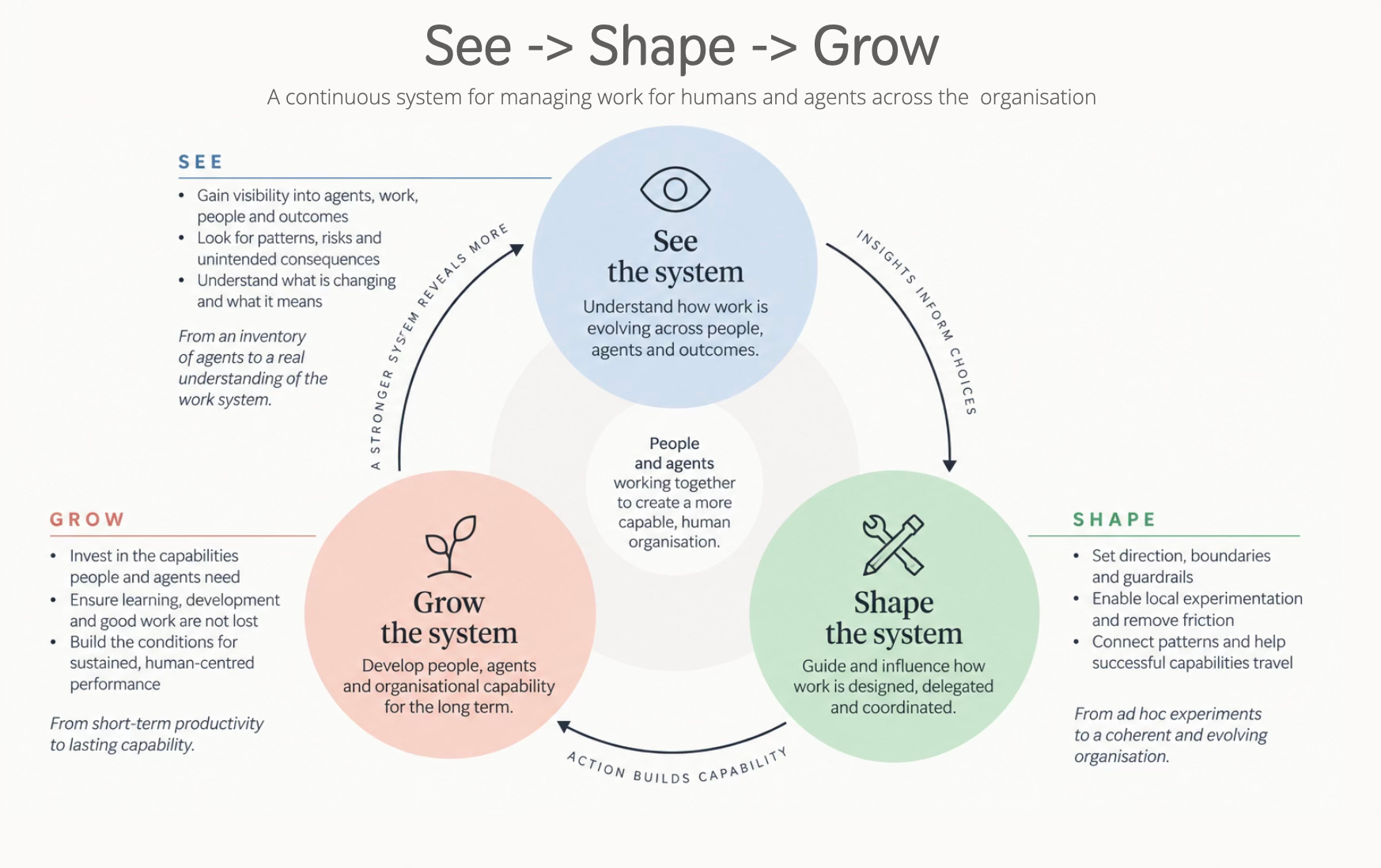
Seeing means developing a much more current picture of how work is actually happening.
Agent registries are one source of that picture, but so are the agents people are building, the problems they are trying to solve, changes in demand, workflow data, customer feedback, learning activity and the experience of the people doing the work. Together, these signals can tell us where capability is emerging, where friction persists and where the formal description of a process or role is drifting away from reality.
The management challenge is not to turn all of this into an enormous control dashboard. It is to make important changes visible early enough that someone can do something useful with them.
Shaping is where leadership becomes active.
Seeing that 50 teams have created similar agents does not tell us what to do about it. Perhaps the organisation should create a shared capability. Perhaps the underlying process or system needs fixing. Perhaps several different approaches should continue because the organisation is still learning which works best.
The same is true at the level of individual work. Leaders increasingly need to make deliberate choices about where judgement sits, what authority an agent should have, which work can disappear altogether and where human involvement remains important.
These are organisational design decisions, even when they begin with someone clicking ‘create agent’.
And shaping cannot be a one-off redesign exercise. As agents improve, people learn and circumstances change, yesterday’s sensible allocation of work may no longer be the right one. The work system needs to remain open to adjustment.
The third act is growing.
This may be the easiest one to miss if we approach agents primarily through productivity. A healthy work system should become more capable over time, not simply more efficient.
That means improving agents as they encounter more situations, capturing useful knowledge and making successful approaches reusable. But it also means deliberately growing the people working alongside them.
If routine work disappears, people need new routes through which to develop judgement. If agents give experienced employees more capacity, some of that could be invested in mentoring, experimentation or solving harder problems. If teams gain greater ability to redesign their own work, they need the skills and authority to do that well.
In other words, we should be interested not only in whether an agent performed today’s work successfully, but whether the combination of people and machines leaves the organisation better able to perform tomorrow’s work. This creates a different role for managers.
A manager in an agent-rich organisation may spend less time distributing tasks, chasing information and coordinating routine activity. But that does not make management less important. It shifts more of the role towards understanding the system around the team: spotting where work is changing, deciding where human attention is most valuable, creating opportunities for people to develop, connecting local experimentation to wider organisational needs and intervening when the system is producing the wrong outcomes.
The manager becomes less important as a router of work and more important as a shaper of capability. That may ultimately be one of the more profound effects of a rapidly growing digital workforce. We tend to ask which parts of employees’ jobs agents will perform. We should probably be asking the same question of management.
If agents can increasingly coordinate activity, gather status, allocate routine work and monitor execution, some of the administrative machinery that grew up around managing scarce human capacity may become less necessary.
What remains - judgement, direction, development, sense-making, creating the conditions for good work, starts to look much more like leadership.
Perhaps, then, the arrival of abundant machine capacity does not diminish the human role in management. It gives us an opportunity to make it more human.
Management infrastructure needs to catch up
This doesn’t require every organisation to construct a perfect digital model of itself before anyone is allowed to create another agent. Nor should better visibility become an excuse to pull decisions back towards the centre. If anything, the speed of change makes that less viable.
The goal is to shorten the distance between something changing in the work, the organisation noticing it, and people being able to respond.
That could mean spotting that multiple teams are solving the same problem and deciding to invest in a shared capability. It could mean noticing that an agent has removed an important learning opportunity and deliberately creating another. It could mean seeing that capacity released in one part of a workflow has simply created a bottleneck somewhere else. Or it might mean recognising that a successful local experiment should remain local because the context that makes it work is specific to that team.
Central functions have a role here, setting guardrails, providing infrastructure, connecting patterns and helping successful capabilities travel. But the people closest to the work need the information and authority to keep changing it.
That creates a rather different management architecture from one designed primarily to cascade plans downwards and report performance upwards.
It is one designed to sense change, interpret what it means and help people act on it while the work is still evolving.
What will we do with abundance?
The obvious response is to consume all of it. But greater output isn’t the only thing we can choose to create. Some of that capacity could create room to learn. Some could allow people to spend longer on difficult decisions, customers or relationships. It could fund experimentation that previously lost out to the urgent work of today. It could give experienced people more time to develop others. And some could simply create enough slack that teams are able to respond to the unexpected without operating permanently at the limit of what they can sustain.
This is why the growth of the digital workforce is ultimately a management question rather than simply a technology or workforce one.
The decisions we make about agents determine more than which tasks machines perform. Collectively, they shape what remains for people to do, where human attention is spent, how expertise develops and what kind of experience work becomes.
Gary Hamel’s challenge was that we had put 21st-century technology on top of 20th-century management processes and 19th-century management principles.
Agentic AI gives us the opportunity to update the technology layer again, this time at extraordinary speed. For the humans working alongside these agents, the more important question is whether we will grasp this opportunity to redesign the management principles underneath it.